Does Alpha Arbutin Work for Post-Acne Dark Marks? (Pakistan Guide)
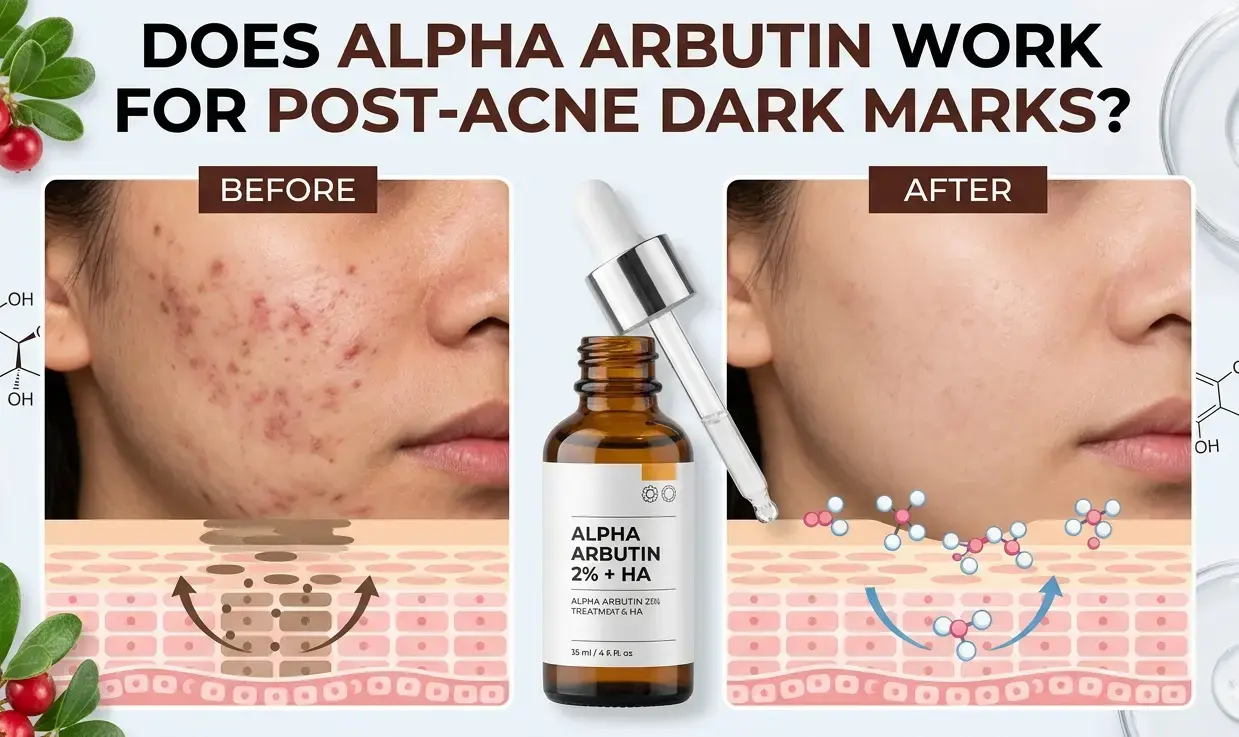
Post-acne dark marks affect almost everyone who has experienced acne in Pakistan — yet most people either wait for them to fade on their own or reach for harsh whitening creams that worsen the skin over time. Alpha arbutin offers a gentler, evidence-backed alternative. This guide explains whether it actually works for acne marks, how long it takes, and how to use it correctly for Pakistani skin and climate.
Introduction
Ask almost anyone in Pakistan who has had acne what bothers them more — the active breakouts or the marks they leave behind — and the answer is almost always the marks. Post-acne dark spots can persist for months, sometimes years, long after the acne itself has resolved. They are visible, they are difficult to cover, and they are the reason so many people in Pakistan reach for whitening creams, exfoliating scrubs, and other aggressive products that frequently make the situation worse rather than better.
Alpha arbutin has emerged as one of the most consistently recommended ingredients for post-acne pigmentation among dermatologists — not because it is the fastest-acting option available, but because it addresses the correct biological mechanism, is safe enough for long-term daily use, and is well-tolerated by the sensitive, often barrier-damaged skin that frequently accompanies acne recovery.
This guide explains clearly what post-acne dark marks are, how alpha arbutin works on them, what realistic results look like, and exactly how to use it in a routine suited to Pakistani skin and climate conditions.
What Are Post-Acne Dark Marks?
One of the most important distinctions to make at the outset is the difference between acne marks and acne scars, because they require different approaches and have very different prognoses.
Acne scars are textural changes to the skin — indentations, raised bumps, or thickened tissue that result from damage to the dermis (the deeper skin layer). These are structural changes that cannot be addressed with topical skincare products alone and typically require professional dermatological procedures.
Post-acne dark marks — clinically called post-inflammatory hyperpigmentation (PIH) — are flat areas of discolouration with no change in skin texture. They are the dark spots that remain after an acne lesion heals. There is no permanent skin damage; the discolouration is a pigmentation response triggered by the inflammation of the acne lesion, not structural injury to the dermis. This distinction matters enormously because PIH, unlike true acne scarring, is responsive to topical brightening ingredients like alpha arbutin.
PIH appears darker and more persistent on South Asian skin types — including Pakistani skin — than on lighter skin tones. This occurs because melanocytes in deeper skin tones are already more active and produce more melanin in response to inflammatory signals. When an acne lesion causes localised inflammation, the melanin response is proportionally stronger, producing deeper discolouration that fades more slowly without intervention. This is not a skin flaw or abnormality — it is a normal physiological difference that simply requires a more deliberate management approach.
Without any intervention and without sun protection, mild PIH on South Asian skin can take 12 to 24 months to fade naturally. With a targeted brightening ingredient like alpha arbutin and consistent daily sunscreen, this timeline can be reduced significantly.
Why Acne Marks Are So Common in Pakistan
The high prevalence of persistent post-acne pigmentation in Pakistan is not simply a matter of genetics — it is shaped by a specific combination of environmental and behavioural factors that are distinct to the Pakistani context.
- Intense UV exposure — Pakistan's UV index regularly exceeds 10 during summer months. UV radiation continuously stimulates melanin production, which means that any area of active PIH exposed to sunlight without protection will continue to darken rather than fade. The absence of daily sunscreen use — still not a consistent habit across most Pakistani skincare routines — is among the most significant reasons acne marks persist.
- Delayed acne treatment — acne in Pakistan is frequently undertreated or treated with inappropriate products for extended periods, allowing inflammatory lesions to persist longer and drive deeper pigmentation responses than would occur with earlier intervention.
- Picking and squeezing pimples — this dramatically increases the severity and duration of PIH by deepening and prolonging the inflammatory signal that triggers melanin overproduction at the lesion site.
- Harsh whitening creams — the widespread use of steroid-containing formula creams in Pakistan creates a compounding problem: the steroids suppress visible inflammation temporarily, masking active acne, while simultaneously damaging the barrier and priming the skin for more severe rebound pigmentation after discontinuation.
- Over-exfoliation — the widespread belief that scrubbing acne marks will fade them faster leads many Pakistani users to over-exfoliate with physical scrubs or high-concentration chemical exfoliants, which worsens barrier function and prolongs the inflammatory state that produces PIH.
- Inadequate moisturisation — dry, dehydrated skin heals more slowly from inflammatory events and produces stronger PIH responses than well-hydrated skin with a healthy barrier.
What Is Alpha Arbutin?
Recommended Alpha Arbutin Serum : KELVS Whitening Serum
Alpha arbutin is a water-soluble, naturally derived glycoside that functions as a tyrosinase inhibitor. Tyrosinase is the enzyme responsible for initiating melanin synthesis — it converts the amino acid tyrosine into the precursors that ultimately become melanin pigment. Alpha arbutin works by binding to the tyrosinase enzyme before this process can begin, reducing the rate at which new melanin is produced.
This mechanism is essentially the same as that of hydroquinone — the conventional gold-standard depigmenting agent — but because alpha arbutin delivers its active component gradually and locally, it does so without the irritation, photosensitisation, and ochronosis risk that make hydroquinone unsuitable for long-term independent use. At cosmetic concentrations of 1 to 2 percent, alpha arbutin has a well-established safety record for continuous daily use on all skin types, including acne-prone and sensitive skin.
This is particularly relevant for acne marks. Skin that is in recovery from an acne lesion is often sensitised and barrier-compromised — exactly the conditions under which harsh depigmenting agents are most likely to cause additional damage. Alpha arbutin's gentle profile makes it one of the few brightening ingredients that can be used safely throughout the acne mark healing process without risking further barrier disruption.
For the complete guide to alpha arbutin: What Is Alpha Arbutin? The Complete Skin Brightening Guide.
How Alpha Arbutin Works on Post-Acne Dark Marks
When an acne lesion forms and heals, it leaves behind a zone of skin where the inflammatory signal has over-stimulated local melanocytes — causing them to produce significantly more melanin than the surrounding tissue. This excess melanin is what creates the visible dark mark. As long as melanin continues to be deposited at this site, the mark will remain visible or deepen.
Alpha arbutin works on acne marks through four interconnected effects:
- Reduces ongoing melanin production — by inhibiting tyrosinase activity at the site of the mark, alpha arbutin reduces the amount of new melanin being deposited daily, allowing the skin's natural turnover to gradually bring unpigmented cells to the surface
- Prevents new marks from deepening — when applied during active acne recovery, alpha arbutin reduces the severity of the PIH that forms at healing lesion sites; marks that would otherwise become darker over weeks of continued melanin deposition are contained at a lower pigmentation level from the outset
- Supports gradual, consistent fading over time — unlike steroid-based products that create artificial temporary lightening, alpha arbutin's fading is real and cumulative; each skin cell turnover cycle brings new, less-pigmented cells to the surface, and the improvement persists as long as the routine continues
- Does not sensitise healing skin — alpha arbutin does not exfoliate, does not alter skin pH, and does not cause photosensitisation; it can be applied directly to areas with active or recently healed acne without increasing inflammation or barrier damage
According to the American Academy of Dermatology, post-inflammatory hyperpigmentation is a direct consequence of the skin's response to acne inflammation — and addressing it requires both preventing new melanin deposition and protecting existing pigmented areas from UV-triggered worsening. Alpha arbutin's dual action on both of these fronts makes it well-matched to PIH management.
How Effective Is Alpha Arbutin for Acne Marks?
The effectiveness of alpha arbutin varies according to the depth and duration of the pigmentation being addressed.
Mild acne marks — recent, superficial PIH from minor breakouts that has been present for less than three months responds well to alpha arbutin within four to eight weeks of consistent use. These marks are the most straightforward to address and typically show clear improvement within a full cell turnover cycle.
Moderate acne pigmentation — marks that are more deeply pigmented, have been present for three to twelve months, or cover larger areas require a longer commitment — typically eight to sixteen weeks of consistent daily use with strict sunscreen — before substantial improvement is visible. Results are achievable but require patience and consistency.
Deep or stubborn marks — very dark, long-standing marks (present for more than twelve months) that have been repeatedly exposed to UV without protection present the most significant challenge. Alpha arbutin can contribute meaningfully to improvement in these cases but is unlikely to produce complete resolution as a standalone ingredient. In these situations, a dermatologist-guided approach incorporating additional prescription-strength depigmenting agents or professional treatments may produce better outcomes.
In all cases, the single most important factor in determining how effective alpha arbutin is for acne marks is whether mineral sunscreen is applied daily. In Pakistan's UV environment, unprotected sun exposure continuously re-triggers melanin overproduction at PIH sites at a rate that can entirely negate the progress of any brightening ingredient. Sunscreen is not supplementary — it is a precondition for alpha arbutin to work.
How Long Does Alpha Arbutin Take to Fade Acne Marks?
| Timeframe | What to Expect | Why It Happens |
|---|---|---|
| Weeks 1 to 2 | Skin feels hydrated and comfortable; no visible change in mark colour yet | Alpha arbutin is establishing tyrosinase inhibition at the cellular level. No surface change is visible at this stage — results require the completion of at least one cell turnover cycle. |
| Weeks 3 to 4 | Some marks may appear marginally lighter; overall skin tone may look more even | The first cell turnover cycle is completing. New, less-pigmented skin cells are beginning to reach the surface. Early improvement is visible in recent, mild marks. |
| Weeks 5 to 8 | Clearer fading of existing marks; skin tone appears more uniform; new marks from recent acne are not deepening | Multiple cell turnover cycles are producing cumulative improvement. Sustained tyrosinase inhibition is reducing melanin in newly surfacing cells while preventing fresh deposition. This is the primary result window for most users. |
| Weeks 8 to 12 | Significant improvement across most mark types; moderate marks substantially faded; overall skin tone notably more even | Full cycle of skin renewal combined with continuous melanin inhibition. Results at this stage represent genuine, non-reversing improvements in PIH rather than temporary suppression. |
| Beyond 12 weeks | Continued gradual improvement; maintenance use prevents recurrence; deep marks continue to fade slowly | Long-standing marks require multiple turnover cycles for complete resolution. Ongoing alpha arbutin use prevents new marks from forming or deepening while existing ones continue to improve. |
Consistency is more important than frequency across this timeline. Missing multiple applications per week significantly extends the required timeframe. A reliable twice-daily routine — even of a single drop — produces better outcomes than a twice-weekly application of multiple drops.
Who Should Use Alpha Arbutin for Acne Marks?
- Teenagers recovering from adolescent acne — alpha arbutin is gentle enough for teenage skin, which is often simultaneously oily, acne-prone, and reactive to active ingredients; it addresses PIH without adding the irritation risk of stronger brightening actives
- Adults with hormonal acne marks — hormonal acne frequently leaves recurring PIH across the jawline, chin, and cheeks; alpha arbutin used continuously provides ongoing prevention of mark deepening and supports the gradual fading of existing marks between breakout cycles
- Sensitive skin users — those who have had reactions to AHAs, vitamin C, or retinol and need a brightening active that can be used without stinging, peeling, or redness
- People recovering from whitening cream irritation — once the skin barrier has been stabilised after discontinuing steroid-containing formula creams, alpha arbutin is one of the first brightening actives that can be safely reintroduced; it addresses the rebound pigmentation that frequently follows steroid cream withdrawal without adding any further barrier stress
- Minimalist skincare users — alpha arbutin performs as a standalone brightening active in a three-to-five-product routine; it does not require combination with multiple other actives to deliver meaningful results for acne marks
How to Use Alpha Arbutin for Acne Marks — Step-by-Step Routine
The following routine is designed for someone using alpha arbutin specifically to address post-acne pigmentation in Pakistan's climate. It is a minimal, purposeful routine that supports barrier health while delivering consistent brightening action.
The most important principle of the layering order is to apply water-based serums like alpha arbutin before any cream or oil-based products. This ensures the active ingredient makes direct contact with the skin surface rather than being diluted or absorbed through a layer of moisturiser.
KELVS Alpha Arbutin Serum is formulated at 2 percent alpha arbutin in a lightweight, fragrance-free base — a concentration that delivers effective tyrosinase inhibition without the irritation risk of higher-concentration formulations. Its water-based texture absorbs quickly and layers cleanly under moisturiser and sunscreen, making it practical for twice-daily use in Pakistan's warm climate.
Full routine:
- Gentle cleanser — use a pH-balanced, sulfate-free, fragrance-free cleanser; lukewarm water only; pat skin dry with a clean towel; do not rub or scrub
- Alpha arbutin serum — apply 2 to 3 drops to clean skin; press gently across affected areas and the full face; allow 60 seconds for full absorption before the next step
- Moisturiser — apply a ceramide-rich, fragrance-free moisturiser while skin is still slightly damp; this locks in hydration and supports the barrier that alpha arbutin does not provide on its own
- Sunscreen (morning only) — mineral sunscreen SPF 30 or above as the final morning step; this is the most critical component of any acne mark routine in Pakistan's UV environment
Morning and Evening Routine Examples
Morning routine:
- Gentle cleanser — remove overnight sebum; lukewarm water; pat dry
- Alpha arbutin serum — 2 to 3 drops; press into skin; 60 seconds absorption
- Lightweight ceramide moisturiser — applied while skin is slightly damp
- Mineral sunscreen SPF 30 or above — final step before going outdoors or near windows; reapply every two hours during prolonged outdoor exposure
Evening routine:
- Double cleanse if wearing sunscreen — micellar water or gentle cleansing oil first; then gentle face cleanser; single gentle cleanse if no sunscreen was worn during the day
- Alpha arbutin serum — 2 to 3 drops on clean skin; 60 seconds absorption
- Ceramide moisturiser — slightly richer formula at night to support the overnight barrier repair and cell renewal processes
Sunscreen is applied only in the morning. The evening routine does not require SPF but does require thorough removal of the morning sunscreen before alpha arbutin application — residual sunscreen reduces absorption.
The importance of sunscreen in this routine cannot be overstated. Without it, UV exposure in Pakistan's climate — particularly in summer months — continuously stimulates melanin production at PIH sites at a rate that exceeds alpha arbutin's inhibitory capacity. Sunscreen transforms alpha arbutin from a slowly effective ingredient to a measurably faster one, simply by removing the competing UV trigger.
Can Alpha Arbutin Be Used on Active Acne?
Yes, alpha arbutin can be applied to skin with mild to moderate active acne. It does not clog pores, does not increase inflammation, and does not interact with common acne treatments such as niacinamide, benzoyl peroxide, or salicylic acid in ways that would make it contraindicated on breakout-prone skin.
It is important to understand what alpha arbutin is and is not doing in this context. It is not treating the active acne lesion — it has no antibacterial, comedolytic, or anti-sebum properties that would address the underlying causes of acne. What it is doing is reducing melanin production at the healing site from the earliest stage, which reduces the severity of the PIH mark that forms when the lesion resolves. Applied consistently throughout an active acne period, it functions as a prevention-and-fade tool — less about treating the pimple, more about managing the discolouration it produces.
For severe, inflammatory, or cystic acne, a dermatologist consultation is recommended for acne management. Alpha arbutin can be used concurrently but should not be considered a substitute for appropriate acne treatment.
Alpha Arbutin vs Niacinamide for Acne Marks
Both ingredients address PIH from acne, but through different mechanisms that are genuinely complementary rather than competing.
- Pigmentation control — alpha arbutin inhibits melanin production at the source via tyrosinase. Niacinamide inhibits melanosome transfer — the movement of melanin from melanocytes to visible surface cells. Together they target two separate steps in the pigmentation process, producing better cumulative results than either alone.
- Oil control — niacinamide reduces sebum production, which directly reduces the frequency and severity of new breakouts — and therefore the new acne marks they produce. Alpha arbutin has no effect on oil production.
- Barrier repair — niacinamide actively stimulates ceramide synthesis, supporting barrier recovery. Alpha arbutin is neutral in this respect. For acne-prone skin with barrier compromise, niacinamide's barrier support role is particularly valuable.
- Best combination approach — use niacinamide in the morning routine for its anti-inflammatory, oil-regulating, and barrier-supporting effects; use alpha arbutin in both the morning and evening for consistent tyrosinase inhibition. The two ingredients are fully compatible and can be applied in the same routine without interaction concerns.
Recommended Niacinamide Serum : KELVS Anti Aging Serum
Alpha Arbutin vs Vitamin C for Acne Marks
Both ingredients contribute to acne mark fading but differ significantly in speed, sensitivity risk, and practical suitability for Pakistani skin types recovering from acne.
- Speed — vitamin C in its L-ascorbic acid form may produce earlier visible improvement in some users, particularly for surface-level pigmentation. Alpha arbutin's results are more gradual — typically four to eight weeks before visible fading begins — but are reliable across all PIH presentations including deeper marks where vitamin C shows less consistent results.
- Sensitivity differences — L-ascorbic acid vitamin C operates at a low pH that frequently causes stinging, redness, and irritation on sensitised or barrier-compromised skin — a common presentation in Pakistani acne-recovery users. Alpha arbutin is pH-neutral and does not cause irritation on acne-affected or recently healed skin. For users whose skin is reactive, alpha arbutin is the more practical choice.
- Best routine strategy — for those who tolerate vitamin C well and want to combine both, apply vitamin C in the morning for its antioxidant defence against daytime UV exposure and alpha arbutin in the evening for targeted PIH control overnight. On sensitive or recovering skin, use alpha arbutin alone as the primary brightening active until the skin has demonstrated full tolerance over several months.
Full comparison: Alpha Arbutin vs Vitamin C — Which Is Better for Dark Spots?
Recommended Vitamin C Serum : KELVS Vitamin C Serum
Common Mistakes When Using Alpha Arbutin for Acne Marks
- Skipping sunscreen — the most consequential mistake in any acne mark routine; Pakistan's UV environment continuously re-stimulates melanin at PIH sites; without daily mineral SPF, alpha arbutin's progress is partially or fully reversed by each day's unprotected sun exposure
- Over-layering actives — adding retinol, AHAs, BHAs, and high-concentration vitamin C simultaneously alongside alpha arbutin creates a cumulative active ingredient load that frequently triggers irritation and new post-inflammatory responses on acne-prone skin; let alpha arbutin work as the primary brightening active before adding other ingredients
- Expecting overnight results — alpha arbutin requires at least four to eight weeks of consistent daily use for visible improvement; users who evaluate results at two weeks and conclude the ingredient is not working are abandoning it before the biology has had time to respond
- Continuing to use whitening creams alongside alpha arbutin — steroid-containing formula creams produce barrier damage and rebound pigmentation that directly competes with and negates the benefits of alpha arbutin; the two approaches are incompatible; one must be chosen and committed to fully
- Inconsistent application — missed applications significantly extend the timeline to visible results; alpha arbutin's gradual tyrosinase inhibition depends on a consistent daily presence in the skin; sporadic use delivers sporadic results
Best Routine for Acne Mark Recovery in Pakistani Weather
Pakistan's climate creates specific practical requirements for any acne mark routine that differ from the conditions assumed in most global skincare content.
Summer heat and humidity — in Karachi, Multan, Hyderabad, and other hot and humid cities, heavy moisturisers and layered serums can contribute to congestion and new breakouts on acne-prone skin. Use a lightweight gel ceramide moisturiser rather than a cream during summer. Keep the serum layer to two products maximum — alpha arbutin and, if using, niacinamide. Avoid heavy oils or occlusives until cooler months.
Dry winter conditions — in Lahore, Islamabad, Peshawar, and during Punjab winters across much of the country, cold air and indoor heating dramatically reduce ambient moisture levels. Switch to a richer ceramide cream at night to prevent trans-epidermal water loss that slows barrier repair and makes PIH more persistent. Sunscreen remains essential in winter — UV radiation is lower in amplitude but still present and still triggers melanin production.
Urban pollution — in Pakistan's more polluted cities, environmental particulate matter deposits on the skin throughout the day and contributes to low-grade inflammation that worsens PIH. Thorough but gentle cleansing at the end of the day, followed by alpha arbutin application, addresses both the residue and the pigmentation simultaneously.
Barrier-damaged skin recovery — for users whose skin has been damaged by whitening cream use and is simultaneously dealing with barrier compromise and post-inflammatory pigmentation, the priority for the first four to six weeks must be barrier repair — a gentle cleanser, ceramide moisturiser, and mineral sunscreen only. Alpha arbutin is then introduced as the skin demonstrates stability, and its results will be better and faster on a repaired barrier than on compromised skin.
When Alpha Arbutin Alone Is Not Enough
Alpha arbutin is effective for the majority of post-acne PIH presentations that are managed independently without prescription intervention. However, there are specific situations where it should be part of a dermatologist-guided plan rather than a standalone approach.
Very deep, long-standing pigmentation — marks that have been present for more than two years, are very dark relative to the surrounding skin, or cover large areas may require additional prescription-strength depigmenting agents, chemical peels, or other professional treatments alongside topical alpha arbutin.
Melasma-type pigmentation confused with acne marks — melasma and PIH can appear similar but have different drivers and require different management approaches. If pigmentation is symmetrical, covers large areas of the cheeks and forehead, or is hormonally triggered, a dermatologist assessment is advisable before beginning a self-managed brightening routine.
True acne scarring — if the concern is textural rather than purely pigmentation-based — including rolling scars, boxcar scars, or ice-pick scars — topical brightening ingredients including alpha arbutin do not address the structural component of the scar. These presentations require professional dermatological management.
According to DermNet's clinical overview of post-inflammatory hyperpigmentation, PIH on darker skin types — including South Asian skin — often requires longer treatment duration and more attentive UV protection than PIH on lighter skin types, and dermatological input is recommended when cases are severe, widespread, or not responding to consistent topical treatment after twelve weeks.
Frequently Asked Questions
Does alpha arbutin remove acne marks permanently?
Alpha arbutin fades existing acne marks and prevents new ones from deepening — but "permanent" removal depends on whether the triggers for PIH are controlled after the routine ends. If UV exposure continues without sunscreen, and if new acne breakouts occur without any brightening intervention, pigmentation will recur or new marks will form. What alpha arbutin provides is reliable fading of existing marks and ongoing prevention when used consistently. The results are real and lasting as long as the routine continues and sun protection is maintained.
How long does alpha arbutin take for acne marks?
Most users begin to see early improvement in mild to moderate acne marks between weeks four and six. More meaningful visible fading is typically evident by weeks eight to twelve for moderate marks, and deeper or long-standing marks may require four to six months of consistent use before showing substantial improvement. Results are directly dependent on daily mineral sunscreen use — without it, the timeline extends significantly regardless of how consistently the serum is applied.
Can alpha arbutin be used daily?
Yes. Alpha arbutin at 1 to 2 percent cosmetic concentrations is safe for twice-daily use in both morning and evening routines. It does not cause photosensitisation, does not accumulate irritation with extended use, and does not require periodic breaks. Consistent daily application is in fact necessary for results — alpha arbutin works through sustained tyrosinase inhibition across multiple cell turnover cycles, which requires reliable daily presence in the skin.
Can I use alpha arbutin with niacinamide?
Yes — this is one of the most widely recommended combinations for post-acne pigmentation. Alpha arbutin reduces melanin production; niacinamide reduces melanin transfer to surface skin cells. Together they target two different steps in the pigmentation process and produce better cumulative results than either alone. Apply niacinamide first, allow it to absorb, then apply alpha arbutin. There are no known incompatibility or interaction concerns between these two ingredients.
Is alpha arbutin safe for sensitive skin?
Yes. Alpha arbutin at cosmetic concentrations is among the most sensitive-skin-compatible brightening actives available. It does not alter skin pH, does not exfoliate the barrier layer, and does not cause the stinging or contact dermatitis associated with stronger depigmenting agents. It is appropriate for use on reactive, acne-prone, barrier-compromised, and recently sensitised skin. For skin currently in active barrier recovery following whitening cream damage, introduce alpha arbutin after four to six weeks of a gentle minimal repair routine, once the skin has demonstrated stability.
Is alpha arbutin suitable for summer in Pakistan?
Yes. Alpha arbutin is thermally stable and does not cause photosensitisation — meaning it does not increase the skin's UV sensitivity, which is a meaningful advantage in Pakistan's summer climate where UV indices regularly reach 10 to 12. It can be used morning and evening throughout the year without seasonal adjustment. The essential paired step is mineral sunscreen SPF 30 or above applied every morning — without this, summer UV exposure will continuously worsen PIH regardless of which brightening ingredient is being used.
Conclusion
Post-acne dark marks are one of the most common and most frustrating skin concerns in Pakistan — and alpha arbutin is one of the most appropriate, evidence-backed, and practically accessible ingredients for addressing them. It works by targeting the correct biological mechanism, it is safe for the sensitised and barrier-challenged skin that frequently accompanies acne recovery, and it can be used continuously as part of a simple daily routine without the risks that accompany stronger depigmenting approaches.
The results require patience. A minimum of six to eight weeks of consistent twice-daily use, combined with non-negotiable daily mineral sunscreen, is the baseline commitment for visible improvement. But the improvement that results is genuine — not a suppression of the skin's normal function, not a temporary lightening effect that reverses on discontinuation, but a real reduction in the pigmentation produced by the acne marks that have been affecting your skin.
Start with the routine. Be consistent. Protect with sunscreen. Give it the time it needs. The marks will fade.