Niacinamide for Dry and Sensitive Skin: Does It Really Help the Skin Barrier? (Pakistan Guide)
Dry and sensitive skin in Pakistan is increasingly common — and increasingly mismanaged. Harsh whitening creams, over-exfoliation, and stripping cleansers deplete the barrier that keeps skin healthy, producing the redness, tightness, and reactive episodes that feel impossible to resolve. Niacinamide works differently: it actively rebuilds the barrier from within, reducing water loss and calming irritation rather than masking it. This guide explains how, and how to use it correctly in Pakistan's climate.
Introduction
Dry and sensitive skin is becoming increasingly common in Pakistan — not because Pakistani skin types have changed, but because the products and routines being used on them have become more damaging. Walk into any pharmacy or beauty salon and you will find formula creams with undisclosed steroids, exfoliating products marketed for daily use, harsh soap-based cleansers positioned as deep-cleaning solutions, and multi-step routines that collectively strip the skin of every protective barrier lipid it has.
The result is a generation of Pakistani skincare users whose skin has become chronically reactive — burning on contact with water, flaking through the day, flushing red in the heat, and intolerant of products it previously handled without issue. This is not a skin type. It is a skin condition: a damaged barrier that no longer functions as it should.
Niacinamide is one of the most specifically useful ingredients for this presentation. Unlike brightening or exfoliating actives that address surface concerns, niacinamide works at the structural level of the barrier — rebuilding the ceramide foundation that dry and sensitised skin has lost, reducing the inflammation driving redness, and restoring the moisture retention capacity that dehydration-driven dryness has depleted. This guide explains how it does this, who it is most appropriate for, and how to build a Pakistan-appropriate routine around it.
What Is the Skin Barrier?
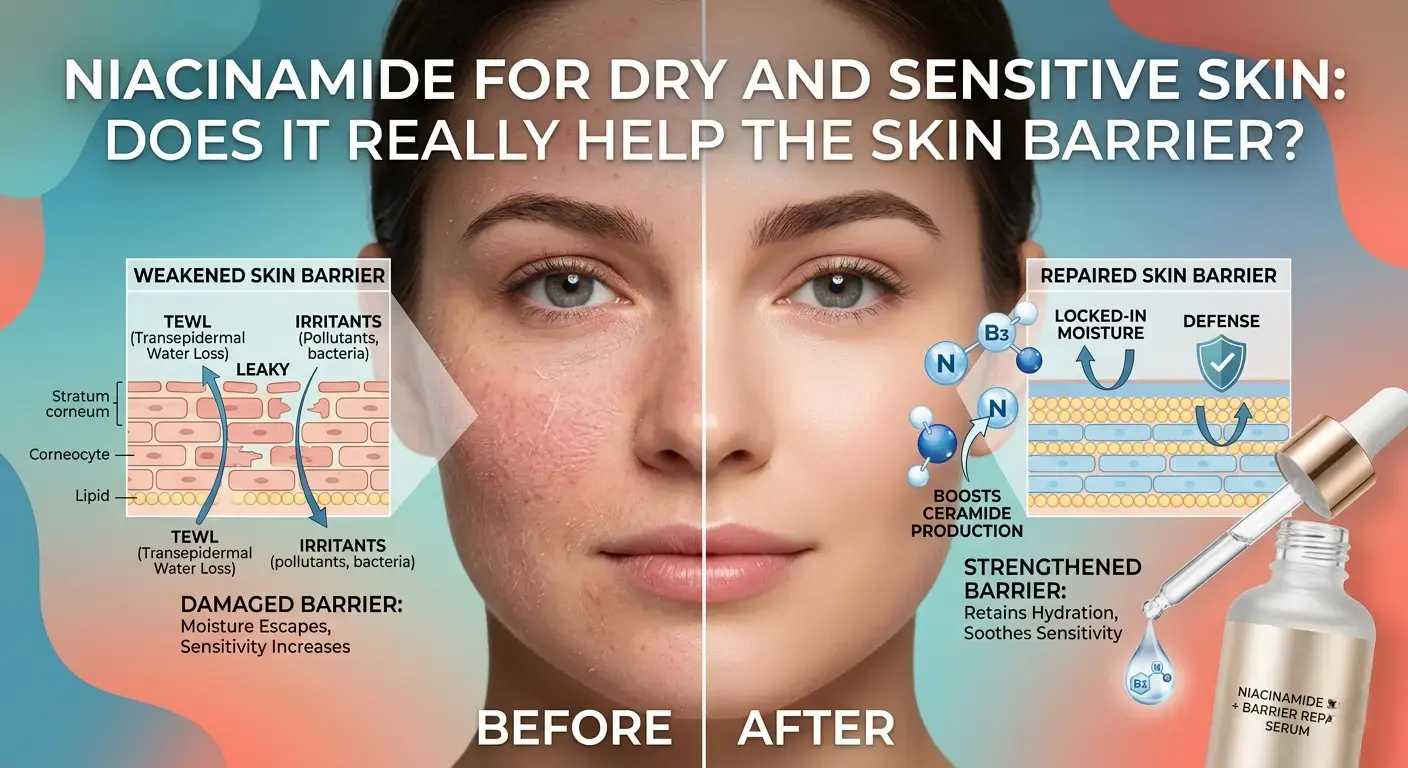
The skin barrier — clinically the stratum corneum — is the outermost layer of the epidermis. It consists of flattened, dead skin cells called corneocytes embedded in a lipid matrix composed of ceramides, cholesterol, and fatty acids. This structure, often described as a brick-and-mortar wall, performs several functions simultaneously that are fundamental to skin health:
- Prevents transepidermal water loss (TEWL) — the lipid matrix seals water inside the skin; when it is intact, skin stays hydrated regardless of ambient humidity; when it is compromised, moisture evaporates continuously from the skin surface, producing chronic dehydration regardless of how much water is drunk or moisturiser applied
- Protects against external irritants — blocks bacteria, allergens, pollutants, and UV radiation from penetrating to the dermis where they would trigger immune responses and inflammation
- Maintains skin pH — preserves the mildly acidic surface environment (pH 4.5 to 5.5) that supports a healthy microbiome and inhibits the overgrowth of pathogenic bacteria
- Regulates immune activity — contains specialised cells that detect and respond to threats proportionally; when the barrier is intact, this response is appropriately calibrated; when compromised, the response is chronic and disproportionate
When the barrier is healthy, skin looks calm, feels comfortable, and tolerates environmental stressors without reacting. When it is damaged — even mildly — the entire system degrades simultaneously. Moisture escapes, irritants penetrate, inflammation becomes chronic, and skin that was once resilient becomes reactive to almost everything.
Signs of a Damaged Skin Barrier
Barrier damage presents across a spectrum from mild to severe, and many Pakistani skincare users are experiencing moderate barrier compromise without recognising it as such. The most common signs include:
- Persistent dryness — skin that feels dry or tight despite regular moisturiser application; the moisturiser provides temporary relief but the underlying dehydration returns quickly because the barrier cannot retain what is applied
- Tightness after washing — skin that feels uncomfortably tight immediately after cleansing; a normal sign of mild barrier disruption from surfactant cleansers, but severe tightness indicates significant lipid stripping
- Redness and flushing — persistent or episodic facial redness, often concentrated around the cheeks, nose, and chin; inflammation at the barrier level becomes visible at the surface
- Burning or stinging — even from gentle products including water, toners, and light moisturisers; a sign that irritants are penetrating through a barrier that can no longer filter them
- Flaking or peeling — the skin sheds outer cells unevenly when the barrier is disrupted; this is often mistaken for a sign that exfoliation is needed, when in fact exfoliation is frequently the cause
- Increased sensitivity to previously tolerated products — suddenly reacting to cleansers, serums, or moisturisers that were used without issue for months; a reliable indicator that the barrier's tolerance threshold has been lowered by cumulative damage
In Pakistan specifically, two products are responsible for a disproportionate share of barrier damage: over-exfoliating products used too frequently, and steroid-containing whitening and formula creams that thin the barrier through prolonged corticosteroid exposure.
What Is Niacinamide?
Niacinamide is the active cosmetic form of vitamin B3 — a water-soluble vitamin essential for skin cell energy metabolism and repair. It is one of the most broadly studied cosmetic actives in dermatology, with a well-established safety record and documented benefits across multiple skin concerns including barrier repair, inflammation, sebum regulation, and pigmentation. For dry and sensitive skin specifically, two of its properties are most clinically relevant: its ceramide-stimulating action, which directly addresses the structural deficit that defines barrier damage, and its anti-inflammatory action, which reduces the chronic irritation that sustains the sensitised skin cycle.
Niacinamide does not exfoliate, does not alter skin pH, and does not cause photosensitisation. These properties — the absence of disruption rather than active harm — are as important as its positive mechanisms for the skin type it benefits most. Sensitive and barrier-compromised skin needs an active that adds without taking; niacinamide is one of the few that reliably does this.
How Niacinamide Helps the Skin Barrier
Niacinamide's barrier support operates through four distinct mechanisms that address the specific deficits of dry and damaged skin simultaneously.
Stimulates Ceramide Production
Ceramides are the dominant lipid component of the skin barrier's mortar matrix — accounting for approximately 50 percent of the total lipid content of the stratum corneum. When ceramide levels are depleted — by harsh cleansers, over-exfoliation, steroid use, or simple ageing — the barrier becomes permeable, allowing moisture out and irritants in. Niacinamide stimulates the synthesis of ceramides within the keratinocytes of the epidermis, measurably increasing ceramide levels in the stratum corneum over consistent use. This is the most direct mechanism by which niacinamide repairs rather than merely soothes barrier-damaged skin.
Reduces Transepidermal Water Loss
As ceramide levels improve and the barrier becomes less permeable, the rate of water evaporation from the skin surface decreases measurably. Users experience this as improved and more sustained hydration — skin that stays comfortable and plump for longer after moisturiser application rather than returning to tightness within an hour. This improvement compounds over weeks of use as ceramide levels continue to rise.
Reduces Skin Inflammation
Niacinamide modulates pro-inflammatory cytokine production in the skin, reducing the chronic inflammatory signalling that drives redness, burning, and the reactive episodes that characterise sensitised skin. This anti-inflammatory effect establishes relatively quickly — many users notice reduced redness and calmer skin within the first week to two weeks of use — before the slower ceramide-building process has had time to produce visible surface changes.
Improves Skin Tolerance Over Time
As ceramide levels rise and inflammation decreases, the skin's tolerance threshold increases. Skin that was previously reactive to a wide range of products becomes progressively less reactive over weeks and months of niacinamide use. This is one of the most clinically meaningful long-term effects of consistent niacinamide use: not just treating the symptoms of barrier damage but restoring the skin's capacity to handle environmental stressors and topical actives without reacting.
According to the American Academy of Dermatology's guidance on restoring the skin barrier, consistent use of ingredients that support ceramide production and reduce inflammation — the two primary mechanisms of niacinamide — is the most evidence-backed approach to managing barrier-compromised skin long-term.
Does Niacinamide Actually Help Sensitive Skin?
Yes — and it is specifically recommended by dermatologists as one of the first active ingredients to introduce for sensitive and barrier-compromised skin, precisely because it repairs the barrier rather than challenging it.
At 2 to 5 percent concentration, niacinamide has a favourable tolerability profile that makes it appropriate for reactive skin types that cannot tolerate more aggressive actives. Unlike alpha hydroxy acids (which exfoliate the barrier), retinoids (which accelerate cell turnover in ways that temporarily worsen barrier function), or high-concentration vitamin C (which requires a low pH that stings on sensitised skin), niacinamide's neutral pH and gentle delivery mechanism produce no disruption to the barrier environment during absorption.
For users who are new to niacinamide, or whose skin is currently in an acute reactive phase following formula cream discontinuation or over-exfoliation, starting at 2 to 3 percent for two weeks before stepping up to 5 percent reduces the already-low risk of any initial adjustment. The very small proportion of users who experience contact dermatitis from niacinamide should discontinue use — but adverse reactions at 2 to 5 percent are genuinely uncommon in clinical practice.
Niacinamide for Dry Skin
For dry skin, niacinamide addresses the condition at a structural level rather than simply providing temporary surface hydration. Its ceramide-stimulating action rebuilds the lipid matrix that dry skin has lost or is deficient in — improving the barrier's capacity to retain the moisture that moisturisers provide, rather than letting it evaporate from a permeable surface within hours of application.
This distinction is important to understand clearly: niacinamide is not itself a moisturiser. It does not provide a physical occlusive or humectant layer on the skin surface. What it does is repair the underlying barrier through which moisturisers must seal water into the skin to be effective. A ceramide moisturiser applied after niacinamide will be retained by an improving barrier more effectively than the same moisturiser applied to a depleted one. Over four to eight weeks of consistent use, users with dry skin find that their moisturiser lasts longer, their skin feels more comfortable between applications, and the cycle of tightness returning within an hour of moisturising gradually breaks.
Niacinamide for Redness and Irritation
Chronic facial redness — particularly the diffuse, persistent flush common in Pakistani users with barrier damage from formula cream use, steroid cream withdrawal, or over-exfoliation — is one of the presentations that niacinamide addresses most visibly and relatively quickly.
The redness in these cases is driven by chronic low-level inflammation — a continuous, disproportionate immune response at the barrier level that becomes visible as persistent surface redness. Niacinamide's modulation of pro-inflammatory cytokines reduces this response without suppressing it (as topical steroids do) — producing a calming effect that is sustainable rather than dependent on ongoing use of a suppressive agent. Unlike steroid-based approaches, niacinamide's redness reduction does not create dependency, does not rebound when discontinued, and improves over time rather than requiring escalating doses to maintain.
For users transitioning off steroid-containing whitening creams, niacinamide is one of the most valuable ingredients to introduce once initial barrier stabilisation has been achieved — addressing the rebound redness and inflammation that frequently accompanies steroid withdrawal without the harsh mechanism that caused the original damage.
Why Barrier Damage Is So Common in Pakistan
The prevalence of dry and sensitive skin in Pakistan is not primarily genetic — it is environmental and behavioural, driven by a specific set of locally common practices and products that collectively compromise the barrier at a rate faster than it can self-repair.
- Steroid-containing whitening and formula creams — topical corticosteroids deplete ceramide production, thin the lipid matrix, and create dependency; their withdrawal produces rebound inflammation that manifests as the redness and sensitivity that many Pakistani users experience as a "new" skin condition when it is in fact a consequence of the cream they have been using
- Over-exfoliation — AHA and BHA products marketed for daily use, physical scrubs used multiple times weekly, and the layering of multiple exfoliating products in the same routine collectively remove the outer barrier layer faster than it can regenerate; this is among the most common self-inflicted causes of sensitised skin in Pakistan's beauty-aware urban population
- Soap-based cleansers and harsh surfactants — traditional soap bars and high-sulfate foaming cleansers strip barrier lipids with every wash; in Pakistan, where multiple-times-daily face washing is common due to heat and humidity, cumulative surfactant damage to the barrier is significant and largely unrecognised
- Hot weather and UV intensity — Pakistan's summer UV index regularly exceeds 10, and UV radiation degrades barrier lipids directly; unprotected daily sun exposure accelerates the barrier depletion that other products begin
- Air conditioning and seasonal dehydration — indoor air conditioning creates a low-humidity environment year-round for many urban Pakistani users, drawing moisture from the stratum corneum even on hot days; combined with Punjab winters, this dehydration significantly reduces the barrier's resilience and recovery capacity
- Strong acne treatments used without barrier support — benzoyl peroxide, high-concentration salicylic acid, and prescription retinoids all produce varying degrees of barrier disruption as side effects; without a barrier-repairing ingredient like niacinamide alongside them, this disruption accumulates into the sensitised presentation being addressed here
For more on formula cream barrier damage: Side Effects of Formula Creams on the Face.
Best Niacinamide Percentage for Sensitive Skin
For sensitive and barrier-damaged skin, 2 to 5 percent niacinamide is the appropriate concentration range. This is where the clinical evidence for barrier repair, anti-inflammatory action, and ceramide stimulation is concentrated, and where the tolerability profile is best for the skin type most likely to be using it for these purposes.
Begin at 2 to 3 percent if the skin is currently in an acute reactive state — actively burning, stinging on contact with most products, or in the rebound phase following formula cream discontinuation. Allow two to four weeks of once-daily use before stepping up to twice-daily use, and two to four further weeks before transitioning to 4 to 5 percent. This gradual introduction significantly reduces the already-low risk of a reaction and gives the skin time to adapt to each new level.
Ten percent niacinamide is not appropriate for sensitive or barrier-damaged skin. The transient flushing that can occur at this concentration — from nicotinic acid conversion — is indistinguishable on reactive skin from a flare reaction, and the additional irritation risk is not justified by the marginal additional benefit over 5 percent for barrier repair purposes.
How to Use Niacinamide for Dry and Sensitive Skin
The routine for dry and sensitive skin should be the simplest it can possibly be while still providing the cleanser, niacinamide, moisturiser, and sunscreen that the skin needs. Every additional product layer increases the cumulative active load and the risk of a reaction on skin that is already at a reduced tolerance threshold.
KELVS Niacinamide Serum is formulated in a lightweight, water-based, fragrance-free base at an effective concentration — appropriate for twice-daily use on sensitive, dry, and barrier-compromised skin. Its simple formulation avoids the unnecessary actives and synthetic fragrances that make reactive skin worse, making it a suitable first serum for users building back from barrier damage. Apply 2 to 3 drops after cleansing, press gently into clean skin — do not rub — and allow 60 seconds for full absorption before the next step.
Full routine for dry and sensitive skin:
- Gentle pH-balanced cleanser — sulfate-free, fragrance-free; the cleanser is the step where the most barrier damage typically occurs in existing routines; switching to a gentler formula is often the single most impactful change a dry or sensitive skin user can make
- Niacinamide serum — 2 to 3 drops pressed gently into clean, slightly damp skin; 60 seconds absorption; pressing rather than rubbing avoids unnecessary friction on reactive skin
- Ceramide-rich moisturiser — fragrance-free; applied while skin is still slightly damp to lock in moisture before it evaporates; this is the step that directly addresses the dryness that the niacinamide barrier repair is building toward sustaining long-term
- Mineral sunscreen SPF 30 or above (morning only) — zinc oxide or titanium dioxide base; mineral formulas are gentler on sensitised skin than chemical UV filters; applied as the final morning step
Morning and Evening Routine for Dry and Sensitive Skin
Morning routine:
- Gentle cleanser — lukewarm water only; hot water dissolves barrier lipids faster than lukewarm and accelerates the dehydration dry skin is already experiencing; pat dry without rubbing
- Niacinamide serum — 2 to 3 drops; pressed in gently; 60 seconds absorption
- Ceramide moisturiser — applied while skin is still slightly damp; for dry skin in Pakistani winters or air-conditioned environments, a richer cream formula rather than a light lotion provides better occlusion
- Mineral sunscreen SPF 30 or above — mineral formula; final morning step; non-negotiable in Pakistan's UV environment even for dry skin that may feel the SPF film drying
Evening routine:
- Gentle cleanse — single gentle cleanse in the evening if a mineral sunscreen was worn; double cleanse only if wearing a particularly heavy or water-resistant SPF; use micellar water first, then gentle cleanser; sensitive skin rarely benefits from more surfactant contact than a single gentle cleanse
- Niacinamide serum — 2 to 3 drops; pressed into clean skin; 60 seconds absorption
- Ceramide moisturiser — richer formula than morning application; the overnight window is when barrier repair and cell renewal are most active; a heavier ceramide cream applied at night provides occlusion that supports this process
No toner. No exfoliant. No facial oil as a separate step during the barrier repair phase — if an oil is used, it should be added as an occlusive final layer over the ceramide moisturiser in the evening only, and only once the skin has demonstrated stability over four to six weeks on the minimal routine. No additional serums during the initial barrier recovery phase — niacinamide as the only active allows the skin to recover without competing stimulation from multiple ingredients.
Ingredients That Work Well with Niacinamide for Dry and Sensitive Skin
- Hyaluronic acid — a humectant that draws water from the deeper skin layers and from the air into the stratum corneum; applied after niacinamide and before moisturiser, it provides the water-phase hydration that ceramide moisturisers then seal in; fully compatible with niacinamide, no interaction concerns
- Ceramides — the most directly complementary ingredient to niacinamide's ceramide-stimulating action; applying ceramides topically alongside niacinamide provides both the building blocks (ceramides in the moisturiser) and the stimulus to produce more (niacinamide's enzymatic action); together they address the barrier lipid deficit from two directions
- Panthenol (provitamin B5) — a soothing, barrier-repairing ingredient that accelerates wound repair, reduces inflammation, and improves ceramide retention; commonly found in well-formulated ceramide moisturisers; works synergistically with niacinamide for sensitive skin
- Alpha arbutin — can be introduced for pigmentation management once the skin has been stable on the minimal routine for four to six weeks; apply niacinamide first, allow absorption, then apply alpha arbutin; the two are fully compatible and complement each other in post-acne or post-whitening-cream pigmentation routines
Ingredients Sensitive Skin Users Should Be Careful With
- High-concentration AHAs and BHAs — glycolic acid above 5 percent, lactic acid above 8 percent, and daily salicylic acid use all exfoliate the barrier layer faster than dry or damaged skin can regenerate; if exfoliation is needed, introduce it at the lowest available concentration, once per week maximum, only after the skin has been stable on the minimal routine for four to six weeks
- Retinoids — appropriate for many skin concerns but poorly matched to the acute barrier repair phase; their cell-turnover-accelerating mechanism temporarily worsens barrier function before improving it; introduce only once the skin is stable and well-supported by a ceramide routine, starting at the lowest available concentration every three days
- Synthetic fragrance and parfum — the most common contact allergen in skincare; sensitised skin has a reduced tolerance threshold that makes fragrance reactions more likely and more severe; avoid in all products across a sensitive skin routine — cleanser, serum, moisturiser, and sunscreen
- Formula creams and whitening creams with undisclosed ingredients — the most urgent avoidance for Pakistani users whose barrier damage was caused by these products; any return to them, even infrequently, perpetuates the barrier compromise that the niacinamide routine is trying to resolve
According to DermNet's clinical review of niacinamide, one of its primary values for sensitised and compromised skin is its compatibility with a simplified routine — it does not require the co-actives or pH manipulation that other actives need, making it the most practical choice for users who need to reduce their total product load while still providing active barrier support.
How Long Niacinamide Takes to Improve Barrier Health
| Timeframe | What Dry and Sensitive Skin Users Can Expect |
|---|---|
| Weeks 1 to 2 | Redness and reactive episodes begin to reduce; skin feels calmer and less easily irritated. Anti-inflammatory action establishes first — before ceramide levels have had time to build significantly. Dryness and tightness may still be present but less acute. |
| Weeks 3 to 4 | Skin tolerates the routine without stinging or burning; moisturiser appears to last longer between applications; visible flaking decreases; overall skin texture begins to smooth. Ceramide synthesis is accumulating, measurably improving barrier permeability. |
| Weeks 5 to 8 | Sustained reduction in dryness and tightness; significantly fewer reactive episodes in response to environmental triggers (heat, wind, air conditioning); skin tone more even; redness noticeably reduced. The barrier is functionally improved at this stage. |
| Weeks 8 to 12 | Skin tolerates a broader range of products and environmental conditions than it did before starting the routine; dry patches resolve or become much less frequent; skin no longer feels fragile or unpredictably reactive. Barrier integrity is demonstrably restored and can support gradual reintroduction of other actives if needed. |
Common Mistakes Sensitive Skin Users Make
- Using too many products simultaneously — adding multiple serums, toners, and treatments to a sensitised skin routine in the belief that more comprehensive coverage will produce faster results; every additional product is an additional variable that increases cumulative irritation risk and makes reaction attribution impossible; start with three products and add only when stability is confirmed
- Choosing the highest concentration of niacinamide — 10 or 20 percent niacinamide on skin that is already reactive introduces flushing risk and potential sensitisation at concentrations that do not provide better barrier repair outcomes than 5 percent; choose the evidence-backed effective range, not the highest available percentage
- Continuing to exfoliate during barrier repair — the most common and most consequential mistake; the skin cannot repair its barrier while an exfoliating product is simultaneously removing its outer layer; chemical exfoliants must be completely paused during the four to eight-week barrier recovery phase
- Skipping moisturiser because skin "doesn't feel that dry" — dry skin in Pakistan during humid summer months can feel dehydrated internally (high TEWL from a compromised barrier) while not feeling dramatically dry at the surface; consistent ceramide moisturiser use is required even when skin feels conditionally comfortable
- Expecting overnight barrier repair — ceramide synthesis and the structural rebuilding of the stratum corneum operate on a four- to twelve-week timeline; visible improvement requires consistent daily application through multiple cell turnover cycles; abandoning the routine at two weeks because redness has not fully resolved is the most common reason barrier recovery stalls
Best Routine for Dry and Sensitive Skin in Pakistani Weather
Pakistan's seasonal and geographic climate variations create specific challenges for dry and sensitive skin that a single routine cannot fully address without adjustment.
Punjab winters (Lahore, Islamabad, Faisalabad — October to February): Cold, dry air and indoor heating create high TEWL conditions that worsen both dry and sensitive skin dramatically. Use a richer ceramide cream in both morning and evening sessions. Apply moisturiser immediately after cleansing before any moisture evaporates from the skin surface. Consider adding a thin layer of a simple non-comedogenic facial oil (squalane works well) as a final evening occlusive over the ceramide cream on the most dehydrating nights. Do not skip sunscreen — winter sun in Punjab is lower in intensity but still present and still triggers the UV-related barrier degradation that compounds dryness.
Summer conditions (across most of Pakistan — May to September): High ambient humidity can create a deceptive sense of skin comfort that masks ongoing TEWL through a compromised barrier. Use a lighter ceramide lotion rather than a cream in the morning; reserve the richer formula for evenings. Mineral sunscreen is critical — UV intensity peaks in Pakistani summer and directly degrades barrier lipids. After outdoor sweating, a single gentle cleanse removes sebum and sweat buildup before evening niacinamide application.
Air-conditioned indoor environments year-round: Air conditioning dramatically reduces ambient humidity and creates a dehydrating indoor environment even in Pakistan's humid summers. If extended time is spent in air-conditioned offices or homes, apply a light layer of hyaluronic acid serum after niacinamide before moisturiser to address the low-humidity water loss that occurs throughout the day.
For the minimal routine framework: Minimalist Skincare Routine for Sensitive Skin in Pakistan.
Who Should Use Niacinamide for Barrier Support?
- Sensitive skin users — those whose skin reacts disproportionately to environmental triggers, new products, or routine changes; niacinamide's anti-inflammatory action calms reactivity while its ceramide-building action progressively raises the skin's tolerance threshold
- Dry skin users — particularly those whose dryness is driven by barrier compromise (TEWL) rather than purely environmental dehydration; niacinamide addresses the structural cause of barrier-driven dryness rather than simply providing surface hydration
- People recovering from whitening cream or steroid cream damage — once the acute reactive phase has been managed with a minimal repair routine (cleanser, ceramide moisturiser, mineral sunscreen) for four to six weeks, niacinamide is the most appropriate first active to introduce; it directly addresses the ceramide depletion that steroid use causes
- Over-exfoliated skin users — anyone whose routine includes daily AHAs, BHAs, or multiple exfoliating products; reducing exfoliation and introducing niacinamide provides the barrier support that exfoliation removes
- People with acne-prone skin that has also become sensitised — the oily-sensitive combination is common in Pakistan; niacinamide addresses both components without forcing a compromise between treating oiliness and protecting barrier function
Frequently Asked Questions
Does niacinamide actually repair the skin barrier?
Yes — through a specific and well-documented mechanism. Niacinamide stimulates ceramide synthesis in the skin's keratinocytes, measurably increasing ceramide levels in the stratum corneum. Since ceramides form approximately 50 percent of the barrier's lipid matrix, this stimulation directly addresses the structural deficit that defines most barrier damage. The effect is not immediate — ceramide synthesis and barrier rebuilding occur over four to twelve weeks of consistent daily use — but it is genuine structural repair rather than surface-level soothing.
Can niacinamide reduce redness on sensitive skin?
Yes. Niacinamide reduces the production of pro-inflammatory cytokines that drive the chronic low-level inflammation responsible for persistent facial redness in sensitive and barrier-compromised skin. This anti-inflammatory effect is typically among the first benefits users notice — often within one to two weeks of consistent use — as it establishes faster than the slower ceramide-building process. Redness reduction is most pronounced in users whose redness is driven by barrier inflammation rather than vascular conditions like rosacea, which may require separate management.
Is niacinamide safe for sensitive skin?
Yes — and it is specifically recommended by dermatologists as one of the first active ingredients appropriate for sensitive skin, precisely because it supports the barrier rather than disrupting it. At 2 to 5 percent, niacinamide does not alter skin pH, does not exfoliate, and does not photosensitise. Its anti-inflammatory and ceramide-stimulating actions work in the same direction as what sensitive skin needs: more barrier stability and less inflammatory activity. Adverse reactions at this concentration range are genuinely uncommon. A patch test on the inner arm over five to seven days is a sensible precaution before full-face application on highly reactive skin.
Can dry skin use niacinamide daily?
Yes — twice-daily use is both safe and appropriate for dry skin, and is what clinical evidence for barrier repair is based on. Consistent daily application is necessary for the ceramide-stimulating effects to accumulate to a level that produces visible barrier improvement. Niacinamide does not dry the skin and does not produce the barrier disruption that exfoliating actives do — it works in the direction of improved moisture retention with each application. Pair with a ceramide moisturiser applied immediately after every niacinamide application for best results.
What percentage of niacinamide is best for sensitive skin?
Two to five percent is the appropriate range. Begin at 2 to 3 percent if the skin is currently in an active reactive or post-formula-cream phase, stepping up to 5 percent after two to four weeks of confirmed tolerance. Five percent is where the clinical evidence for barrier repair and anti-inflammatory action is strongest. Ten percent and above is not appropriate for sensitive or barrier-damaged skin — the flushing risk at this concentration is poorly matched to a skin type that is already reactive, and the incremental benefit over 5 percent for barrier repair does not justify it.
Can niacinamide be used with moisturiser on the same routine?
Yes — and it should be. Niacinamide is not a moisturiser and does not provide the occlusive or humectant functions that a ceramide moisturiser provides. The two work together: niacinamide stimulates the skin's own ceramide production from within, while a ceramide moisturiser provides supplementary lipids at the surface and seals water into the stratum corneum. Apply niacinamide to clean skin, allow 60 seconds of absorption, then apply moisturiser. This sequence ensures maximum niacinamide absorption before the occlusive layer is applied.
Conclusion
Dry and sensitive skin in Pakistan is not a fixed skin type that people are born with and cannot change — in many cases, it is an acquired condition driven by specific products, habits, and environmental factors that are very common in Pakistan and very correctable with the right approach. Niacinamide is one of the most specifically appropriate tools for this correction: rebuilding the ceramide foundation of the barrier, reducing the inflammation that makes skin reactive, and improving the moisture retention that chronic TEWL has depleted.
Used consistently at 2 to 5 percent, in the context of a deliberately simple routine with a gentle cleanser, a ceramide moisturiser, and daily mineral sunscreen, niacinamide produces genuine, structural improvement in dry and sensitive skin over eight to twelve weeks. The improvement compounds over time and makes the skin progressively more tolerant — the opposite of the reactive escalation cycle that harsh products create. For skin that has been through that cycle in Pakistan, niacinamide is frequently where recovery begins.