Niacinamide Side Effects: Is Skin Purging Real — and When Should You Stop? (Pakistan Guide)
Niacinamide is one of the most well-tolerated ingredients in skincare — but that does not mean it causes zero reactions for zero people. When irritation or breakouts occur after starting niacinamide, the instinct to call it "purging" and push through is often the wrong response. This guide explains what is actually happening, how to tell purging from irritation, what causes genuine niacinamide reactions, and when to stop.
Introduction
When you start a new skincare product and your skin reacts — breaks out, turns red, feels tight or uncomfortable — the question almost everyone asks is the same: is this normal, or is something wrong? In skincare communities online, the default answer has become "it's purging, push through." But this response, applied carelessly to every reaction on every product, has led a significant number of Pakistani skincare users to continue using products that are actively irritating their skin, believing they are working through a temporary phase when in fact the routine is causing harm.
Niacinamide is one of the most well-tolerated cosmetic actives available. Reactions to it are genuinely less common than with more aggressive ingredients. But "generally well-tolerated" does not mean "universally reaction-free" — and when reactions do occur, the reason is almost never skin purging in the classical sense. Understanding what is actually causing the reaction, and what the response should be, is the difference between a productive and a harmful skincare experience.
This guide explains the real side effects of niacinamide, what purging is and whether niacinamide actually causes it, how to tell a normal adjustment from a genuine irritation response, and exactly when to stop using niacinamide and seek dermatological guidance.
What Is Niacinamide?
Niacinamide is the active cosmetic form of vitamin B3 — a water-soluble vitamin used widely in skincare for its oil-regulating, barrier-repairing, anti-inflammatory, and tone-evening properties. It is one of the most studied cosmetic actives in dermatological literature, with a well-established safety profile and documented benefits across oily, acne-prone, sensitive, and barrier-damaged skin types. At concentrations of 2 to 5 percent, niacinamide is appropriate for twice-daily indefinite use on most skin types without the photosensitisation, exfoliation, or barrier disruption that make other actives riskier on reactive skin.
Its mechanism — stimulating ceramide synthesis, modulating inflammatory cytokines, inhibiting melanosome transfer, and regulating sebaceous gland activity — does not involve accelerating cell turnover or physically disrupting the barrier layer. This is a critical distinction for understanding why it does not typically cause the purging phenomenon that exfoliating actives and retinoids can produce.
Is Niacinamide Usually Safe?
Yes — and more broadly safe than most active skincare ingredients. The dermatological literature consistently describes niacinamide as one of the best-tolerated cosmetic actives across all skin types, including sensitive, acne-prone, and barrier-compromised presentations. Unlike alpha hydroxy acids, retinoids, benzoyl peroxide, or high-concentration vitamin C — all of which carry meaningful risk of irritation, dryness, or peeling — niacinamide at 2 to 5 percent produces adverse reactions in a genuinely small proportion of users.
However, "safe" and "reaction-free for everyone in all circumstances" are different statements. Problems with niacinamide in Pakistan most commonly arise from three sources: overuse at concentrations too high for the individual's skin, layering alongside other actives that create a combined irritation load, and applying it to a skin barrier that is already significantly compromised and therefore less tolerant of even gentle actives. None of these scenarios reflect a problem with niacinamide itself — they reflect a mismatch between the product and the routine or skin condition it is being used on.
Common Niacinamide Side Effects
When niacinamide does cause adverse reactions, the following presentations are the most commonly reported. Understanding what each looks like and what causes it helps users determine whether what they are experiencing is a minor, self-resolving adjustment or a signal to modify or stop the routine.
Temporary Redness or Flushing
At concentrations of 10 percent and above, niacinamide can convert in part to niacin (its precursor form) in the skin. Niacin causes cutaneous vasodilation — expansion of surface blood vessels — that produces a transient flush: warmth, redness, and sometimes a slight burning sensation. This typically appears within minutes of application and resolves within 20 to 30 minutes without intervention. It is not an allergic reaction and is not harmful, but it is uncomfortable and for many users is a signal that the concentration is higher than their skin tolerates comfortably. Stepping down from 10 percent to 5 percent typically resolves this completely.
Mild Stinging or Burning
Mild stinging on initial niacinamide application — particularly in the first few days of use — can reflect temporary sensitivity of a recently cleansed or slightly dehydrated skin surface rather than a true adverse reaction to niacinamide. If it resolves within 30 seconds and does not recur after the first week, it is usually a self-limiting adjustment. Persistent stinging that does not reduce after two weeks of consistent use is a sign to reassess concentration, supporting products, or barrier status.
Itching
Mild itching in the minutes after application can accompany the flushing response at higher concentrations, or can indicate early contact sensitivity to niacinamide or to a co-ingredient in the formula (most commonly synthetic fragrance or a preservative). If itching persists beyond the immediate application window and recurs with every use, it is a sign the formula is not tolerated — discontinue and patch-test a fragrance-free alternative.
Tightness or Dryness
Tightness after niacinamide application is almost always caused by a co-ingredient or by insufficient moisturiser rather than niacinamide itself, which is a barrier-supporting ingredient that does not strip or dehydrate the skin. If tightness occurs, check whether the formula contains alcohol (denat.) or strong surfactants, and ensure a ceramide moisturiser is applied over the serum immediately after absorption.
Small Breakouts
New small breakouts appearing after starting niacinamide are one of the most common concerns and one of the most frequently misunderstood. These are not purging in the classical dermatological sense — they are almost always caused by a co-ingredient in the niacinamide formula (particularly mineral oils, silicones, or heavy emollients in non-serum formats), by the combined irritation of niacinamide introduced alongside other actives in an already-loaded routine, or by a formula that contains fragrance or comedogenic ingredients that are triggering the breakouts independently of the niacinamide itself.
Does Niacinamide Actually Cause Skin Purging?
No — not in the classical dermatological definition of purging, and this distinction is important enough to address directly.
Skin purging is a specific phenomenon: it occurs when an active ingredient accelerates the skin's cell turnover rate, causing microcomedones (subclinical clogged follicles already forming beneath the surface) to surface and become visible faster than they would have without the treatment. The ingredients that cause genuine purging are those that directly increase cell turnover speed — retinoids (tretinoin, retinol, retinal), alpha hydroxy acids at exfoliating concentrations, and certain BHA preparations.
Niacinamide does not accelerate cell turnover. Its mechanisms — ceramide stimulation, sebum modulation, anti-inflammatory signalling, melanin transfer inhibition — do not involve speeding up the process by which skin cells shed and replace. There is therefore no biological mechanism by which niacinamide would cause genuine purging. When breakouts appear after starting a niacinamide product, the cause is elsewhere — in the formula, in the broader routine, or in the timing of introduction.
The persistence of the "purging" narrative around niacinamide in Pakistani skincare communities is primarily a product of online advice that applies the purging concept broadly to any reaction on any new product — which leads users to push through genuine irritation or incompatibility reactions under the mistaken belief that they are a productive temporary phase. They are not.
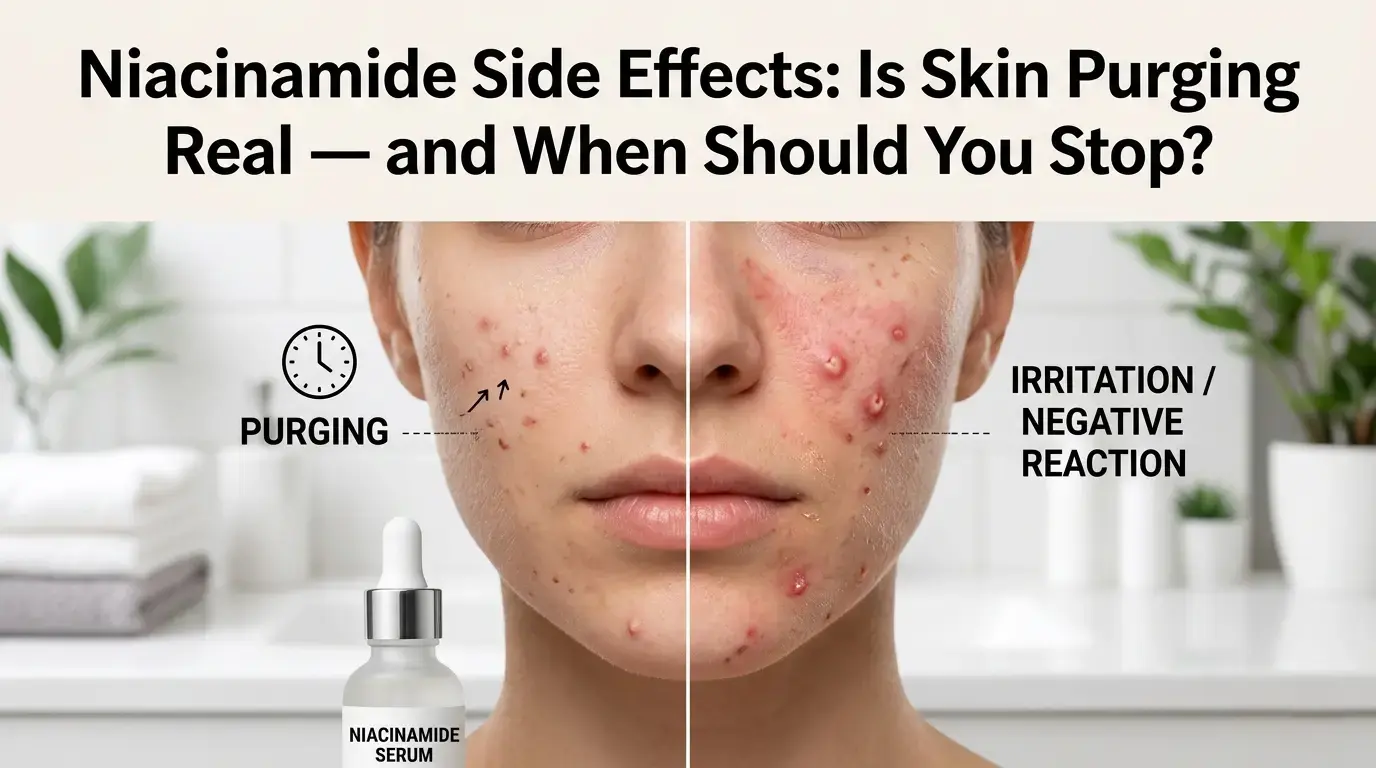
Purging vs Irritation — How to Tell the Difference
| Characteristic | Purging (from cell-turnover actives) | Irritation / Incompatibility (from niacinamide misuse) |
|---|---|---|
| Timing of onset | Typically begins within the first 2 to 6 weeks of starting a retinoid or AHA | Can begin immediately or within days of starting the product |
| Type of breakouts | Same type as the skin's usual breakouts — comedones, papules consistent with the user's acne pattern | Often different from usual breakouts — small, clustered, or uniform bumps; may appear in areas not previously prone to acne |
| Location | In areas where acne typically forms for that individual | Can appear anywhere — including areas that do not usually break out, particularly around the mouth and cheeks |
| Duration | Typically self-resolves within 4 to 8 weeks of consistent use | Persists or worsens as long as the offending product is used; does not resolve on its own with continued application |
| Burning or redness | Mild dryness possible; significant burning or redness is not a feature of purging | Often accompanied by burning, redness, stinging, or skin sensitivity beyond breakouts |
| Response to stopping | Stopping the active pauses the purge — microcomedones surface more slowly | Skin typically calms and improves within a few days to two weeks of discontinuing the offending product |
| Correct response | Continue at reduced frequency if tolerable; give it 8 weeks before concluding the product is not suitable | Stop. Identify the cause (formula ingredient, concentration, or routine overload) and address it before reintroducing |
The key clinical distinction is whether the breakouts are consistent with the user's existing acne pattern (possible purge from a cell-turnover active) or are a new, different breakout pattern appearing in new locations with accompanying redness or burning (irritation or incompatibility). Niacinamide is not a cell-turnover active, so any breakouts attributed to it should be assessed as irritation or incompatibility rather than purging.
Why Some People Break Out After Using Niacinamide
When niacinamide is identified as the likely cause of new breakouts, there are several specific, identifiable reasons — none of which are purging.
Comedogenic or Irritating Co-Ingredients
A niacinamide serum is not just niacinamide. Formulae contain emollients, humectants, stabilisers, preservatives, and sometimes fragrance — any of which can clog pores or irritate the skin independently of the niacinamide itself. Heavy silicones, mineral oils, and certain emollients in poorly formulated niacinamide products are the most common cause of breakouts attributed to niacinamide that are actually caused by the vehicle rather than the active. Switching to a simpler, fragrance-free, non-comedogenic niacinamide formula often resolves these breakouts without abandoning niacinamide itself.
Overloaded Multi-Active Routine
Introducing niacinamide into a routine that already contains retinol, high-concentration AHAs, benzoyl peroxide, and vitamin C creates a combined active load that frequently produces acneiform eruptions — breakouts driven not by any one ingredient but by the cumulative irritation of too many aggressive actives applied simultaneously. In Pakistan, where skincare influencer culture has popularised the idea of using every trending ingredient at once, this is an extremely common cause of new breakouts incorrectly attributed to individual ingredients.
High-Concentration Flushing Triggering Skin Stress
At 10 percent and above, niacinamide's conversion to niacin and the resulting flushing reaction can trigger a low-level inflammatory response that, on acne-prone skin, contributes to new breakouts. The mechanism is not purging — it is flush-triggered inflammation producing the acneiform response. Stepping down to 5 percent eliminates the flushing and the associated breakout risk.
Applying to a Compromised Barrier
Barrier-damaged skin — including skin recovering from formula cream use, over-exfoliation, or steroid cream withdrawal — has a reduced tolerance for even gentle actives. Introducing niacinamide into a routine before the barrier has been adequately stabilised can produce stinging, redness, and skin instability that may present as new breakouts. The solution is to stabilise the barrier first (a minimal routine of gentle cleanser, ceramide moisturiser, and mineral sunscreen for four to six weeks) before introducing any active serum.
Can High Niacinamide Percentages Irritate Skin?
Yes — and this is the concentration-related cause of most niacinamide adverse reactions in Pakistan's skincare market, where 10, 15, and 20 percent niacinamide products are sold with the implicit message that higher is more effective.
At concentrations above approximately 7 to 10 percent, niacinamide converts more readily to niacin in the skin. Niacin causes cutaneous flushing — a prostaglandin-mediated vasodilatory response that produces transient but uncomfortable redness, warmth, and sometimes burning. On sensitive or acne-prone skin, this inflammatory flush can contribute to new breakouts. On Pakistani skin in summer heat, the flush is more pronounced and more prolonged than in temperate climates.
The clinical evidence for niacinamide's documented benefits — oil control, barrier repair, anti-inflammatory action, melanin transfer inhibition — is concentrated at 4 to 5 percent concentration. Higher percentages do not produce proportionally better outcomes and carry a meaningfully higher risk of the reactions described above. For Pakistani users experiencing irritation from niacinamide, the first intervention should be stepping down to 5 percent before considering discontinuation.
Signs You Should Stop Using Niacinamide
Not all reactions are signals to stop — but some are. The following presentations indicate that niacinamide (or the formula containing it) is not appropriate for the skin's current condition, and that continuing use will cause more harm than benefit.
- Persistent burning or stinging that does not reduce after two weeks — a temporary adjustment sensation in the first few days may be acceptable; burning that continues with every application after two weeks of consistent use is not a normal adjustment and indicates incompatibility or barrier compromise
- Severe or spreading redness beyond the application area — redness confined to application areas and resolving within 30 minutes of a single application may be flushing; redness that spreads, worsens with each application, or persists throughout the day indicates a more significant reaction requiring discontinuation
- A rash-like eruption with bumps, hives, or itching — this presentation, distinct from typical acne, indicates allergic contact dermatitis to niacinamide or a formula co-ingredient; discontinue immediately and consult a dermatologist before reintroducing any niacinamide product
- Painful, cystic, or deep breakouts appearing in new locations — particularly around the mouth and jaw in areas that do not typically break out; this is an irritation response, not purging, and will not improve with continued application
- Worsening skin sensitivity over time rather than improving — niacinamide should, over consistent use, produce progressively more tolerant, calmer skin through its anti-inflammatory and barrier-repairing effects; if skin becomes progressively more reactive over four to eight weeks of use, something in the routine is incompatible and needs to be identified and removed
According to the American Academy of Dermatology's guidance on skin product reactions, any skincare reaction that worsens rather than improves over time, or that includes hives, severe redness, or significant swelling, should be assessed by a dermatologist who can identify the specific ingredient responsible and advise on appropriate management — rather than managed by continuing the routine or simply switching products independently.
How to Use Niacinamide Safely
Most niacinamide side effects are preventable through a careful introduction protocol and routine structure. The following approach is appropriate for any skin type introducing niacinamide for the first time, but particularly important for sensitive, acne-prone, or barrier-compromised skin in Pakistan.
KELVS Niacinamide Serum is formulated at 5 percent in a lightweight, fragrance-free, water-based base — a concentration and formula structure that minimises the flushing risk of higher concentrations and the comedogenic or irritation risk of poorly formulated alternatives. Its simple ingredient list makes it one of the most straightforward options for users who want to verify that any reaction is not caused by a complex vehicle formula.
Safe introduction routine for niacinamide:
- Patch test first — apply a small amount to the inner arm or jaw for five to seven consecutive days before full-face application; any redness, bumps, stinging, or itching during this window indicates the formula is not tolerated and should not be applied to the full face
- Begin with once-daily evening application — apply 2 to 3 drops to clean skin in the evening only for the first two weeks; this reduces the daily exposure during the tolerance-establishing phase and makes it easier to identify which session is causing any reaction
- Gentle cleanser before application — pH-balanced, sulfate-free, fragrance-free; the cleansing step sets the baseline for the skin surface that niacinamide will be applied to; a harsh or stripping cleanser immediately before application increases sensitivity to whatever follows
- Ceramide moisturiser immediately after — do not allow niacinamide to sit on the skin without a moisturiser over it; apply a ceramide moisturiser within 60 seconds of niacinamide absorption to support the barrier and reduce any surface sensitivity
- Mineral sunscreen in the morning (once daily application is established) — when stepping up to twice-daily use, add mineral SPF 30 or above as the final morning step; this protects the barrier progress niacinamide is building and reduces the UV-triggered inflammatory signals that increase skin reactivity
- Step up to twice daily after two weeks of confirmed tolerance — once the once-daily protocol produces no adverse reaction over two full weeks, add the morning application; allow another two weeks before concluding the full routine is well-tolerated
How Often Should Beginners Use Niacinamide?
Once daily for the first two weeks, then twice daily — this is the protocol that minimises adjustment reactions while establishing the biological accumulation that produces visible results. The tendency among Pakistani skincare beginners is to start immediately at full twice-daily use, influenced by the expectation that faster or more frequent application produces faster results. In practice, for sensitive or barrier-compromised skin, the opposite is true: the skin that starts at once daily and tolerates the gradual introduction will maintain consistent use far longer than the skin that starts at twice daily, reacts, and abandons the routine entirely.
Consistency over intensity is the operational principle for niacinamide use. A once-daily routine maintained for twelve weeks will produce better results than twice-daily use that is disrupted or abandoned after four weeks due to a reaction.
Best Routine for Sensitive and Acne-Prone Skin in Pakistan
Pakistan's specific skincare context — over-exfoliation culture, whitening cream misuse, formula cream-related barrier damage, and the challenge of managing both heat-driven oiliness and UV-driven pigmentation — creates a population with an unusually high proportion of barrier-compromised, reactive skin. For this skin type, the niacinamide introduction protocol above is not excessive caution; it is appropriate clinical practice.
The multi-active overload problem: Pakistani skincare social media culture promotes routines that combine niacinamide with retinol, salicylic acid, vitamin C, AHAs, and alpha arbutin simultaneously. For healthy, barrier-intact skin, some of these combinations are manageable. For the significant proportion of Pakistani users with barrier damage from formula cream use or over-exfoliation, this combined active load produces reliable irritation — often incorrectly attributed to individual ingredients rather than to the total routine burden.
The whitening cream recovery context: many Pakistani users seeking to start a "proper" skincare routine are doing so while simultaneously withdrawing from steroid-containing formula creams. Their skin is at its most sensitised and barrier-depleted precisely when they are most motivated to start active skincare. For these users, niacinamide should be introduced only after four to six weeks of a strictly minimal barrier repair routine — not immediately as their first serum purchase.
Heat and sweating: Pakistan's summer heat increases the intensity of any flushing reaction from higher-concentration niacinamide. In summer months particularly, step down from 10 percent to 5 percent if any flushing occurs — the ambient heat amplifies the vasodilatory response and makes the reaction more uncomfortable and more prolonged than it would be in a temperate climate.
For the minimal routine approach: Minimalist Skincare Routine for Sensitive Skin in Pakistan.
Common Mistakes That Cause Niacinamide Irritation
- Choosing the highest available concentration immediately — the belief that 20 percent niacinamide is four times better than 5 percent is not supported by evidence; 5 percent is where the clinical documentation for all niacinamide benefits is concentrated; 20 percent delivers nothing additional and introduces significantly more flushing and irritation risk
- Adding niacinamide to an already-overloaded multi-active routine — the most common cause of breakouts and irritation incorrectly attributed to niacinamide; introduce niacinamide into a simplified two-to-three-product routine and add other actives only after tolerance is confirmed
- Over-exfoliating the skin before or during niacinamide use — applying niacinamide to skin that has been over-exfoliated — either by daily AHA/BHA use or by physical scrubbing — applies an active to a compromised barrier that cannot buffer it as a healthy barrier would; the combination produces exaggerated sensitivity reactions that are attributed to niacinamide but are actually the result of the exfoliation
- Mixing niacinamide with very low-pH acids in the same step — applying L-ascorbic acid vitamin C (pH 2.5 to 3.5) and niacinamide in the same skin surface without an absorption interval can contribute to the niacin conversion and flushing reaction; while not dangerous, it increases the risk of the transient flush that some users experience at higher concentrations; allow 60 seconds between each serum application
- Applying to skin that is actively damaged or in acute reactive distress — niacinamide is barrier-supportive, not barrier-proof; applying it to skin that is currently oozing, severely inflamed, or in the acute phase of steroid cream withdrawal will produce stinging and irritation because the barrier through which it must penetrate is not functioning; stabilise first, introduce actives after
How Long Mild Irritation Usually Lasts
For genuine, mild adjustment irritation — the first few days of slight stinging or redness that resolves within 30 minutes of application and does not recur after the first week — the expectation is that it resolves entirely within seven to ten days of consistent once-daily use. This is the only presentation that warrants the "push through" response, and even then, it should be paired with reduction to once-daily use and immediate application of a ceramide moisturiser over the serum.
Irritation that persists beyond two weeks of consistent use, that worsens with continued application, or that is accompanied by significant redness, burning, new breakouts in unusual locations, or an itchy rash is not a normal adjustment and will not resolve by pushing through. It is a signal that the product, the concentration, or the routine is not appropriate for the skin's current condition — and the correct response is to stop, simplify, and identify the cause before reintroducing.
Can Niacinamide Damage the Skin Barrier?
In the majority of use cases, no — niacinamide is a barrier-supportive ingredient whose ceramide-stimulating action actively repairs and strengthens the skin barrier over consistent use. The dermatological literature does not identify niacinamide at standard cosmetic concentrations as a barrier-damaging ingredient.
However, two scenarios can produce barrier stress in the context of niacinamide use. First, if the routine surrounding niacinamide contains barrier-disrupting elements — harsh cleansers, over-exfoliation, high-concentration retinoids — niacinamide's barrier-supportive action cannot compensate for active barrier damage being caused by other products. The barrier stress in this scenario is caused by the surrounding routine, not by niacinamide. Second, at very high concentrations (10 percent and above) on already-sensitised skin, repeated flushing reactions can produce a low-level chronic inflammation that, over time, does not support barrier function despite niacinamide's theoretical barrier benefit. This is why stepping down to 5 percent is the first response to any niacinamide irritation, rather than discontinuation.
According to DermNet's clinical review of niacinamide, it is classified as a barrier-supportive cosmetic active with no documented direct barrier-damaging effects at standard cosmetic concentrations — a characterisation that applies specifically to well-formulated products used at appropriate concentrations on skin whose barrier is not in acute compromise.
Who Should Be Extra Careful with Niacinamide?
- Very sensitive or highly reactive skin — those whose skin reacts to a wide range of products; introduce niacinamide at 2 to 3 percent with once-daily use, patch test for a full week before full-face application, and step up concentration and frequency only after confirmed tolerance over two to four weeks
- Rosacea-prone skin — rosacea involves a compromised barrier and heightened vascular reactivity; niacinamide at 5 percent is generally well-tolerated and beneficial for rosacea (its anti-inflammatory action is specifically useful), but higher concentrations that risk flushing should be strictly avoided, as any vasodilatory stimulus worsens rosacea reactivity
- Over-exfoliated skin — anyone currently using AHAs or BHAs daily, or who has recently over-exfoliated; the compromised barrier state of over-exfoliated skin reduces tolerance for even gentle actives; pause exfoliation entirely for two to four weeks before introducing niacinamide
- People recovering from whitening cream or steroid cream damage — this is the group most likely to encounter niacinamide when their skin is at its most vulnerable; introduce niacinamide only after four to six weeks of a strictly minimal barrier repair routine (gentle cleanser, ceramide moisturiser, mineral sunscreen only), once the skin has demonstrated stability and reduced reactivity on that foundation
Frequently Asked Questions
Does niacinamide cause skin purging?
No — not in the clinical definition of purging. Purging is caused by ingredients that accelerate cell turnover, causing subclinical microcomedones to surface faster than they would naturally. Niacinamide does not accelerate cell turnover — it inhibits melanosome transfer, stimulates ceramide synthesis, and regulates sebum and inflammation. There is no biological mechanism by which niacinamide would cause genuine purging. New breakouts after starting niacinamide are caused by formula co-ingredients, routine overload, high-concentration flushing, or barrier compromise — not by purging.
How do I know if niacinamide is irritating my skin versus adjusting normally?
Normal adjustment: mild, brief stinging that resolves within 30 minutes of application and does not recur after the first week of use. Irritation: persistent burning, redness, or stinging that occurs with every application; breakouts in new locations not associated with the usual acne pattern; a rash-like eruption or hives; skin that becomes progressively more reactive rather than calmer over four to eight weeks of consistent use. If the reaction fits the irritation description rather than the adjustment description, the product or routine is not appropriate for the skin's current condition.
Can niacinamide cause breakouts?
It can — but not through purging. The most common causes of niacinamide-associated breakouts are comedogenic co-ingredients in the formula (not the niacinamide itself), flushing-triggered inflammation at 10 percent and above, and the cumulative irritation of adding niacinamide to an already multi-active routine. Switching to a simpler, fragrance-free niacinamide formula at 5 percent and introducing it into a stripped-back routine usually resolves these breakouts without abandoning niacinamide entirely.
Should I stop using niacinamide if I break out?
It depends on the nature of the breakouts. Small, clustered, uniform bumps in areas that do not usually break out, accompanied by redness or burning: stop and reassess the formula and routine. Breakouts consistent with your usual acne pattern appearing in their usual locations, without burning or redness: this is more likely triggered by a co-ingredient or routine issue and worth investigating before stopping niacinamide entirely. In either case, simplify the routine first — remove all other actives — before attributing the breakout to niacinamide specifically.
Is 10% niacinamide too strong for Pakistani skin?
For many Pakistani users, yes — particularly those with sensitive, barrier-damaged, or acne-prone skin that is already dealing with inflammation. The flushing risk at 10 percent is amplified by Pakistan's heat and by a skin population with an unusually high prevalence of barrier compromise from formula cream use and over-exfoliation. Five percent niacinamide delivers all of the clinically documented benefits at a concentration where the flushing risk is negligible for most users. There is no compelling reason to use 10 percent niacinamide on Pakistani skin dealing with typical concerns of oiliness, acne marks, and barrier sensitivity.
Can sensitive skin use niacinamide safely?
Yes — with appropriate concentration selection and introduction protocol. Begin at 2 to 3 percent niacinamide, once daily, with a patch test preceding full-face use. Step up to 5 percent after two to four weeks of confirmed tolerance. Support with a ceramide moisturiser applied immediately after every application. Keep the rest of the routine minimal — no other actives during the introduction phase. At 2 to 5 percent in a fragrance-free formula, niacinamide is one of the most sensitive-skin-compatible active ingredients available, and its anti-inflammatory action actively reduces the reactivity that makes sensitive skin so difficult to improve with other ingredients.
Conclusion
Niacinamide is among the safest cosmetic actives available — but "generally safe" and "guaranteed reaction-free for everyone" are not the same. When reactions occur, they are almost never purging (which niacinamide cannot cause) and almost always traceable to a specific, addressable cause: concentration too high, formula too complex, barrier already compromised, or routine overloaded with competing actives.
The correct response to a niacinamide reaction is to identify and address the specific cause — step down concentration, simplify the formula, reduce the routine's total active load, or allow the barrier to stabilise before reintroducing — rather than either pushing through under the mistaken purging narrative or abandoning a genuinely beneficial ingredient entirely.
For Pakistani skin specifically — navigating a climate that stresses the barrier, a market full of barrier-damaging products, and skincare advice that often encourages more rather than less — the most protective approach is simplicity: a well-formulated 5 percent niacinamide at once daily, in a minimal routine, on a barrier that has been given the chance to stabilise first. The results accumulate. The reactions that so frequently occur with more aggressive approaches do not.