Alpha Arbutin vs Kojic Acid — Which Fades Dark Spots Faster? (Pakistan Guide)
Alpha arbutin and kojic acid are both tyrosinase-inhibiting brightening ingredients — but they differ significantly in speed, safety, and suitability for sensitive skin. This guide compares both head to head across every major pigmentation concern common in Pakistan, from acne marks and melasma to sun pigmentation and whitening cream recovery, and gives you a clear framework for choosing the right one.
Introduction
Dark spots, uneven skin tone, acne marks, and melasma are among the most searched skin concerns across Pakistan. A combination of year-round intense UV exposure, high rates of post-acne hyperpigmentation, widespread hormonal pigmentation, and the long-term skin effects of unregulated whitening creams has made brightening one of the defining priorities of Pakistani skincare routines.
Two ingredients appear consistently in evidence-backed brightening discussions: alpha arbutin and kojic acid. Both inhibit melanin production. Both have real clinical evidence behind them. Both are found in brightening serums sold in Pakistan. And yet they are meaningfully different — in how aggressively they work, how well they tolerate sensitive skin, and how safely they can be used in Pakistan's UV-intensive climate over the long term.
This guide compares alpha arbutin and kojic acid directly across every major pigmentation concern relevant to Pakistani skin, explains their respective safety profiles, and gives you a straightforward decision framework for choosing between them — or using both strategically.
What Causes Dark Spots in Pakistan?
Understanding what drives pigmentation matters because the cause often determines which brightening ingredient is the more appropriate choice.
- Sun exposure — Pakistan's UV index regularly exceeds 10 during summer months across Karachi, Lahore, Multan, and interior cities. Repeated UV exposure over-stimulates melanocytes, producing concentrated melanin deposits as sunspots, freckling, and diffuse darkening on exposed skin areas.
- Post-inflammatory hyperpigmentation from acne — acne lesions trigger localised inflammation that stimulates melanin overproduction at the healing site. The resulting flat dark marks are among the most prevalent skin concerns in Pakistan across all age groups.
- Melasma — hormonally triggered, UV-worsened darkening that produces symmetrical patches across the cheeks, forehead, and upper lip. It is frequently seen in Pakistani women during and after pregnancy and in those using hormonal contraception.
- Inflammation from other causes — any chronic inflammatory event, including eczema, contact dermatitis, and reactions from harsh skincare products, can leave residual hyperpigmentation.
- Whitening cream misuse — steroid-containing formula creams produce rebound hyperpigmentation after discontinuation, leaving skin significantly darker than its original tone in many Pakistani users. This specific pigmentation presentation requires a gentler, more gradual brightening approach during recovery.
For more on whitening cream-related skin damage: Side Effects of Formula Creams on the Face.
What Is Alpha Arbutin?
Alpha arbutin is a water-soluble glycoside derived from the bearberry plant. It functions as a tyrosinase inhibitor — it binds to the enzyme that initiates melanin synthesis, reducing the rate at which new pigment is produced in skin cells. As the skin's natural cell turnover cycle brings fresher, less-pigmented cells to the surface over four to twelve weeks of consistent use, existing dark spots gradually fade and new pigment deposition is reduced.
At the concentrations used in cosmetic formulations — typically 1 to 2 percent — alpha arbutin is among the most well-tolerated brightening actives available. It does not alter skin pH, does not exfoliate the barrier layer, and does not cause photosensitisation. This safety profile distinguishes it clearly from older depigmenting agents like hydroquinone, which carry documented risks of irritation, paradoxical darkening, and systemic concerns with long-term unregulated use — and which are found in numerous Pakistani formula creams without disclosure.
For a full breakdown of alpha arbutin: What Is Alpha Arbutin? The Complete Skin Brightening Guide.
What Is Kojic Acid?
Kojic acid is a naturally occurring organic acid produced as a byproduct of the fermentation of certain fungi, most commonly Aspergillus oryzae (koji fungus), and is also found in fermented foods like sake, soy sauce, and rice wine. In skincare, it functions as a chelating tyrosinase inhibitor — it binds to the copper ions that the tyrosinase enzyme requires to function, disrupting melanin synthesis more directly and often more aggressively than alpha arbutin.
Kojic acid has a well-established track record in dermatological brightening and is used in both prescription and OTC formulations. It is generally effective for pigmentation, particularly stubborn sun-related spots and areas of concentrated melanin. However, its more aggressive mechanism comes with a more significant sensitivity and irritation profile than alpha arbutin — particularly at the concentrations found in many commercially available products.
According to DermNet's clinical review of kojic acid, while it is effective as a depigmenting agent, its use is associated with a higher incidence of contact dermatitis and irritation than gentler tyrosinase inhibitors, particularly in users with sensitive or compromised skin.
How Alpha Arbutin Works for Dark Spots
Alpha arbutin's mechanism is targeted and gradual. By competitively binding to the tyrosinase enzyme before melanin synthesis can be initiated, it steadily reduces the rate of pigment production over an extended period. This gradual action means results take longer to appear than with more aggressive depigmenting agents — but the improvement is genuine, non-reversing, and does not depend on barrier suppression to maintain.
Alpha arbutin is particularly well-suited to the following presentations common in Pakistan:
- Acne marks (PIH) — by inhibiting tyrosinase during the post-inflammatory window when acne marks would otherwise deepen, alpha arbutin prevents new pigment deposition and gradually fades existing marks through cell turnover
- Melasma support routines — continuous melanin production inhibition reduces the rate of new pigment accumulation in chronically overactive areas; appropriate as a daily maintenance active within a broader dermatologist-guided melasma plan
- Diffuse uneven tone — areas of generalised uneven pigmentation from accumulated sun exposure respond to consistent alpha arbutin use over eight to twelve weeks
- Sensitive and barrier-damaged skin — its gentle profile makes it one of the first brightening actives that can be safely reintroduced for users whose skin has been damaged by whitening creams, once the barrier has been stabilised
- Long-term safe routines — alpha arbutin can be used continuously without medical supervision, without periodic breaks, and without the accumulation of irritation or ochronosis risk associated with stronger depigmenting agents
For those recovering from the barrier damage and rebound pigmentation caused by steroid-containing whitening creams, KELVS Alpha Arbutin Serum provides a gentle 2 percent alpha arbutin formulation in a fragrance-free, sulfate-free base — one of the most appropriate brightening options to introduce once the skin has stabilised on a minimal repair routine.
How Kojic Acid Works for Dark Spots
Kojic acid inhibits tyrosinase through chelation — it binds to the copper ions that are essential for the enzyme's activity, effectively disabling it rather than simply competing with the substrate as alpha arbutin does. This more direct mechanism produces stronger and in many cases faster visible brightening than alpha arbutin at equivalent application frequencies.
Kojic acid is well-suited to the following presentations:
- Stubborn sun pigmentation — concentrated sunspots and areas of significant UV-related darkening that have not responded well to gentler ingredients
- Visible pigmentation requiring faster improvement — where a stronger depigmenting action over a shorter period is the priority
- Short-term targeted brightening routines — used strategically rather than as an indefinite daily active, kojic acid can produce meaningful improvement in localised areas over four to eight weeks
However, kojic acid's more aggressive mechanism brings significant caveats for sensitive skin users. It is more likely to cause contact dermatitis, redness, and barrier disruption than alpha arbutin — particularly at concentrations above 1 percent or with daily use on compromised skin. In Pakistan, where a significant proportion of skincare users have barrier damage from prior harsh product use, this risk profile is a meaningful limitation.
Alpha Arbutin vs Kojic Acid — Head-to-Head Comparison
| Consideration | Alpha Arbutin | Kojic Acid |
|---|---|---|
| Mechanism | Competitive tyrosinase inhibition via glycoside binding | Copper chelation — disables tyrosinase more directly |
| Pigmentation Strength | Moderate to strong — effective across all pigmentation types | Strong — particularly effective on stubborn, concentrated pigmentation |
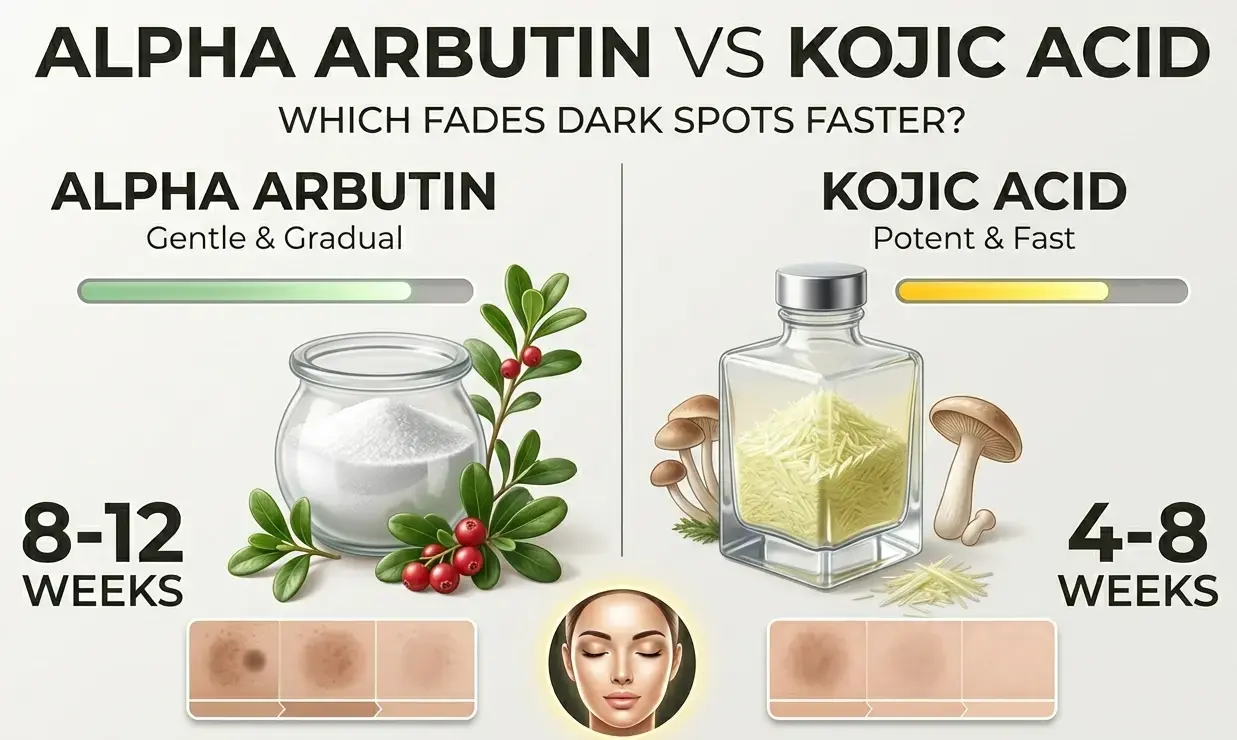
| Speed of Results | Gradual — visible improvement from weeks 4 to 8 | Faster — some visible change from week 2 to 4 in many users |
| Sensitivity Risk | Low — well-tolerated including on reactive and compromised skin | Moderate to high — contact dermatitis and irritation documented, especially above 1% |
| Barrier Friendliness | High — no pH disruption, no exfoliation, no barrier interference | Moderate — can disrupt barrier integrity with frequent use or at higher concentrations |
| Melasma Suitability | Better for long-term daily management | Supportive but higher irritation risk limits sustained use |
| Acne Mark Effectiveness | Better — specifically suited to post-inflammatory pigmentation in gentle routines | Effective but irritation risk increases on inflamed or recently healed acne skin |
| Summer Suitability in Pakistan | High — stable in heat; no photosensitisation | Moderate — can increase photosensitivity; strict SPF essential |
| Daily Use Safety | Yes — safe for twice-daily use long-term | Caution — daily use at full concentration increases irritation and sensitisation risk |
| Long-Term Use | Suitable for indefinite ongoing use | Better used in cycles — periodic rest from kojic acid reduces cumulative irritation |
Which Ingredient Works Faster?
Kojic acid produces faster visible changes for most users. Its more direct enzyme-disabling mechanism means some users notice early brightening within two to four weeks — particularly on surface-level pigmentation and recent sunspots. Alpha arbutin's gradual competitive inhibition typically requires four to eight weeks before visible improvement becomes apparent, as results depend on the skin's natural cell turnover cycle bringing new cells to the surface.
Weeks 1 to 2: Some kojic acid users notice slight lightening of recent, superficial dark spots. Alpha arbutin users typically notice no visible change at this stage — the ingredient is working at the cellular level before surface changes occur.
Weeks 3 to 4: Kojic acid users with surface pigmentation may see measurable fading. Alpha arbutin users begin to see early improvement in recent acne marks and diffuse unevenness as the first cell turnover cycle completes.
Weeks 5 to 8: Both ingredients are producing visible results. Alpha arbutin's improvement becomes more pronounced and reliable across all pigmentation types. Kojic acid continues to show strong improvement but some users experience increased sensitivity at this stage of sustained use.
Speed, however, must be weighed against sustainability. Kojic acid's faster results come with a higher rate of discontinuation due to irritation — particularly in Pakistan, where a significant portion of users have sensitive or already-compromised skin. A slower-acting ingredient that can be used consistently for twelve or more weeks will ultimately produce better outcomes than a faster-acting one that must be stopped at week four due to a reaction.
Which Ingredient Is Better for Sensitive Skin?
Alpha arbutin is unambiguously the more appropriate choice for sensitive, reactive, or barrier-compromised skin. Its gentle mechanism does not require a low pH environment, does not chemically exfoliate, and does not cause the copper-chelation-related irritation that makes kojic acid challenging on compromised skin.
Kojic acid's irritation risk on sensitive skin is well-documented. Users who have experienced reactions to harsh products, who are recovering from whitening cream damage, or who have a history of contact dermatitis are at substantially higher risk of adverse reactions from kojic acid — particularly at the concentrations found in commercially available brightening serums and creams in Pakistan.
For users in the barrier repair phase following formula cream or steroid cream discontinuation, kojic acid should not be introduced until the skin has demonstrated full stability and normal tolerance over several months. Alpha arbutin, by contrast, can be introduced much earlier in the recovery process once initial barrier stabilisation has been achieved.
Which Ingredient Works Better for Acne Marks?
Alpha arbutin has a clear advantage for post-inflammatory hyperpigmentation from acne. The reasoning is both mechanistic and practical.
Mechanistically, acne marks form during a window of elevated inflammatory activity at the healing lesion site. Alpha arbutin's gentle but targeted tyrosinase inhibition reduces pigment deposition during this sensitive window without further stressing already-inflamed skin. Kojic acid's stronger mechanism can be effective on older, more established acne marks — but applying a higher-irritation ingredient to recently healed or actively inflamed skin increases the risk of worsening the post-inflammatory response rather than resolving it.
Practically, acne marks are an ongoing concern rather than a one-time event — new breakouts continuously produce new marks. This means the brightening ingredient being used for acne marks needs to be appropriate for continuous daily use over many months. Alpha arbutin's long-term daily-use safety profile is better matched to this requirement than kojic acid's need for periodic cycling.
Which Ingredient Works Better for Melasma?
For melasma — hormonally triggered, UV-driven pigmentation requiring sustained long-term management — alpha arbutin is the more reliable choice for daily independent use.
Melasma management requires consistent, ongoing inhibition of melanin production across affected areas, combined with absolute UV protection. Alpha arbutin's suitability for continuous daily use without the cumulative irritation concerns of kojic acid makes it a more practical cornerstone of a long-term melasma maintenance routine. Its lack of photosensitisation is also significant in Pakistan's UV environment — where any increase in UV sensitivity directly worsens the condition being treated.
Kojic acid can contribute meaningfully to melasma improvement, particularly in short-term intensive cycles, but its irritation profile and photosensitivity considerations limit its role to periodic, carefully managed use within a broader melasma plan rather than as a continuous daily active.
According to the American Academy of Dermatology's guidance on melasma treatment, the most effective management strategy combines a tyrosinase-inhibiting topical with strict daily broad-spectrum sun protection — a pairing that alpha arbutin supports more reliably than kojic acid in independent daily use due to its superior photosensitivity profile.
Which Ingredient Is Better for Stubborn Pigmentation?
For stubborn, deeply concentrated pigmentation — including longstanding sunspots, post-inflammatory marks that have been present for more than six months, or significant sun damage on areas like the forehead and cheeks — kojic acid offers a stronger short-term depigmenting effect than alpha arbutin.
Its direct enzyme-disabling mechanism produces more pronounced brightening on established, concentrated pigmentation than alpha arbutin's competitive inhibition. For users with healthy, non-sensitive skin who want to address stubborn spots over a defined period of four to eight weeks, kojic acid used at 1 percent concentration, with rigorous daily mineral sunscreen and a barrier-supporting moisturiser, can deliver meaningful results.
The critical caveats are careful use and clear expectations. Kojic acid for stubborn pigmentation should be introduced gradually, used at the lowest effective concentration, and supported by a generous, ceramide-rich moisturiser to buffer any barrier disruption. It should be patch-tested before full-face application, and any signs of irritation — redness, stinging, excessive dryness — should prompt immediate reduction in frequency.
Can You Use Alpha Arbutin and Kojic Acid Together?
Yes — but with strategic restraint rather than simultaneous daily application.
The combination of both ingredients targets melanin production through complementary mechanisms: alpha arbutin's competitive binding and kojic acid's copper chelation together produce stronger cumulative tyrosinase inhibition than either ingredient alone. For users without sensitivity concerns, using both in the same routine is theoretically possible — but the practical risk is that kojic acid's irritation potential is additive with any other active in the routine, and using it alongside multiple other ingredients increases the cumulative load on the skin.
The most appropriate strategy for most Pakistani users considering both ingredients:
- Use alpha arbutin as the daily, consistent brightening active in both morning and evening routines
- Introduce kojic acid two to three times per week in the evening routine — rather than daily — to deliver its stronger depigmenting action on targeted areas without accumulating the irritation that comes with daily use
- On evenings when kojic acid is used, apply it after cleansing, allow full absorption, then follow immediately with a ceramide-rich moisturiser to support the barrier
- Apply mineral sunscreen SPF 30 or above every morning without exception — kojic acid's photosensitisation risk makes this even more critical than with alpha arbutin alone
This approach allows users to benefit from kojic acid's faster action on stubborn spots while maintaining the consistent, safe daily brightening that alpha arbutin provides — without compounding the irritation risk of both actives applied at full daily frequency.
How to Use Alpha Arbutin in a Routine
Morning routine:
- Gentle, pH-balanced, fragrance-free cleanser — lukewarm water; pat dry
- Alpha arbutin serum — 2 to 3 drops applied to clean skin; press gently; allow 60 seconds to absorb
- Ceramide moisturiser — applied while skin is slightly damp to seal in hydration
- Mineral sunscreen SPF 30 or above — final step; non-negotiable in Pakistan's UV environment
Evening routine:
- Double cleanse if wearing sunscreen — micellar water first, then gentle cleanser; single cleanse if not
- Alpha arbutin serum — 2 to 3 drops; press into clean skin; allow 60 seconds to absorb
- Ceramide moisturiser — slightly richer formula at night to support overnight barrier repair
How to Use Kojic Acid Safely in a Routine
Introduction protocol:
- Patch test first — apply to the inner forearm or jaw for five to seven consecutive days before full-face application; do not proceed if irritation, redness, or stinging occurs
- Begin at a lower frequency — two to three evenings per week rather than daily; increase only if the skin demonstrates full tolerance over two to three weeks
- Use the lowest available concentration — 1 percent formulations are appropriate for most users; concentrations above 2 percent significantly increase irritation risk without proportionally increasing efficacy for most skin types
Evening routine incorporating kojic acid:
- Gentle cleanser — pH-balanced; pat dry
- Kojic acid product — apply to targeted areas or full face as tolerated; allow full absorption; this step replaces the alpha arbutin serum on evenings when kojic acid is used
- Ceramide-rich moisturiser — applied immediately after kojic acid absorption; this is not optional — barrier support following kojic acid application reduces cumulative irritation significantly
Morning after kojic acid use:
Apply mineral sunscreen SPF 30 or above without fail. Kojic acid increases photosensitivity, and the morning after application is a particularly important window for UV protection. Skipping sunscreen on a day following kojic acid use directly counteracts its brightening effect and risks worsening the pigmentation being treated.
Which One Should You Choose?
- Sensitive skin: Alpha arbutin — it does not cause photosensitisation, does not disrupt skin pH, and can be used daily without the accumulating irritation risk associated with kojic acid
- Acne marks (PIH): Alpha arbutin — its gentle profile suits the inflamed skin environment of post-acne healing better than kojic acid's stronger action
- Melasma: Alpha arbutin — more appropriate for the continuous long-term daily use that melasma management requires
- Stubborn, concentrated pigmentation on healthy skin: Kojic acid — its more direct mechanism delivers stronger brightening on established, resistant dark spots
- Faster short-term visible improvement: Kojic acid — with appropriate frequency management and strict sun protection
- Daily safe long-term routine: Alpha arbutin — suitable for indefinite use without periodic breaks or cumulative sensitisation concerns
- Whitening cream recovery: Alpha arbutin — the gentler re-entry brightening option for barrier-damaged skin
Best Choice for Pakistani Skin Types and Climate
Pakistan's environmental conditions create several practical considerations that are relevant specifically to this ingredient comparison.
Heat and stability: Both alpha arbutin and kojic acid are reasonably stable across Pakistan's temperature range. Alpha arbutin's stability advantage is greater — it degrades less than kojic acid under repeated heat exposure. In Pakistan's extreme summer temperatures in cities like Multan, Sukkur, and Jacobabad, product storage in cool, dark locations applies to both but matters more for kojic acid formulations.
UV intensity and photosensitisation: Pakistan's UV index regularly reaches 10 to 12 in summer. Kojic acid's documented increase in photosensitivity is a meaningful concern in this environment — using kojic acid without rigorous daily mineral SPF in Pakistani conditions risks worsening pigmentation rather than improving it. Alpha arbutin does not cause photosensitisation and carries no additional UV-related risk beyond what any brightening routine in Pakistan's climate already requires.
Whitening cream recovery cases: A substantial segment of Pakistani skincare users is actively recovering from barrier damage caused by steroid-containing formula creams. For this group, kojic acid is not an appropriate immediate choice — its irritation profile is poorly matched to compromised, barrier-damaged skin. Alpha arbutin is the appropriate brightening re-entry point once the skin has demonstrated stability on a gentle minimal routine for four to six weeks.
Pollution and urban environments: In Pakistan's more polluted cities, niacinamide paired with alpha arbutin addresses both pigmentation and environmental stress. Kojic acid, while effective for pigmentation, does not provide the barrier-supportive or anti-inflammatory benefits that are additionally useful in high-pollution environments.
How Long Results Take When Using Either Ingredient
Weeks 1 to 2: Kojic acid may produce early visible lightening of recent, surface-level spots in some users. Alpha arbutin produces no visible surface change at this stage — it is working at the enzymatic level before results are visible.
Weeks 3 to 4: Kojic acid users with sun pigmentation often notice measurable fading. Alpha arbutin users begin to see early improvement in acne marks and uneven tone as the first cell turnover cycle completes.
Weeks 5 to 8: Both ingredients are producing meaningful visible results. Alpha arbutin's improvement is broad and consistent across pigmentation types. Kojic acid continues to show strong results on stubborn spots but cumulative sensitivity requires monitoring at this stage of sustained use.
Beyond 8 weeks: Alpha arbutin's results continue to improve and are maintained with ongoing use. Kojic acid is appropriately used in cycles at this point — a period of active use followed by a rest period before resuming — rather than indefinite daily application.
In all cases, the results of both ingredients are directly dependent on daily mineral sunscreen use. Without SPF, UV exposure in Pakistan's climate continuously re-stimulates melanin production at a rate that overwhelms either ingredient's inhibitory action. Sunscreen is not a supplementary step — it is half the treatment.
Common Mistakes When Using Kojic Acid or Alpha Arbutin
- Over-layering actives — adding vitamin C, retinol, AHAs, and BHAs into the same routine alongside either brightening ingredient increases cumulative irritation without proportionally increasing results; keep the routine purposefully simple, particularly when kojic acid is involved
- Using kojic acid too frequently — daily kojic acid use above 1 percent concentration accumulates irritation and sensitisation over time; two to three applications per week is a more sustainable and safer frequency for most users
- Skipping sunscreen — the most consequential mistake with both ingredients; alpha arbutin reduces melanin production and kojic acid inhibits tyrosinase, but both are overwhelmed by continuous UV exposure without SPF; sunscreen is non-negotiable
- Expecting overnight results — both ingredients operate on the skin's cell turnover timeline; visible improvement requires a minimum of four to eight weeks of consistent, daily use; abandoning a product before this window has passed means investing time and product for no visible outcome
- Using either ingredient alongside ongoing whitening cream use — continuing to apply steroid-containing formula creams while adding alpha arbutin or kojic acid to the routine is counterproductive; the barrier damage and unknown active ingredient load of formula creams creates an unpredictable, often harmful combined effect that negates the benefit of any well-formulated brightening ingredient
Frequently Asked Questions
Is alpha arbutin safer than kojic acid?
In most cases, yes. Alpha arbutin at cosmetic concentrations is well-tolerated by most skin types, including sensitive and barrier-compromised skin, without the contact dermatitis risk, photosensitisation, and cumulative irritation that kojic acid carries at equivalent use frequencies. For users with healthy, non-reactive skin, kojic acid used at appropriate concentrations and frequencies is also safe — but the margin for error is smaller, and the consequences of overuse are more significant than with alpha arbutin.
Which fades pigmentation faster?
Kojic acid typically produces faster visible brightening, particularly on recent or surface-level pigmentation, with some users noticing improvement within two to four weeks. Alpha arbutin's gradual mechanism produces visible results from weeks four to eight. The faster action of kojic acid comes with a higher incidence of irritation and discontinuation, which means alpha arbutin's slower but more consistently tolerated action often produces better total outcomes over a full eight to twelve-week period.
Can both be used together?
Yes, but strategic separation rather than simultaneous daily application is recommended. Use alpha arbutin as the daily consistent active in both morning and evening routines, and introduce kojic acid two to three evenings per week as a more targeted brightening intervention on established spots. Support all kojic acid applications with a ceramide moisturiser immediately after absorption, and apply mineral sunscreen the following morning without fail.
Is kojic acid safe for daily use?
Daily use of kojic acid at concentrations above 1 percent over extended periods increases the risk of contact dermatitis, skin sensitisation, and barrier disruption in a significant proportion of users. For most people, daily use is not recommended as a long-term strategy. Two to three applications per week at 1 percent concentration, supported by a barrier-reinforcing moisturiser and consistent sunscreen, is a more sustainable approach. Alpha arbutin is the more appropriate choice for those requiring a daily brightening active.
Which is better for acne marks?
Alpha arbutin is the better choice for post-inflammatory hyperpigmentation from acne. Its gentle mechanism is appropriate for the inflamed, recently healed skin environment where acne marks form — reducing pigment deposition during the most active window without the irritation risk that could worsen the inflammatory response. Kojic acid can be used for older, more established acne marks but is less appropriate for active or recently healed skin.
Which ingredient is safer in summer in Pakistan?
Alpha arbutin is more appropriate for summer use in Pakistan's high-UV climate. It does not cause photosensitisation — meaning it does not increase the skin's sensitivity to UV radiation — and is thermally stable in high temperatures. Kojic acid's documented photosensitisation risk is a meaningful concern in a country where UV index values of 10 to 12 are routine during summer months. Users choosing to use kojic acid in summer should apply it exclusively in the evening and apply mineral sunscreen SPF 30 or above every morning without exception.
Conclusion
Alpha arbutin and kojic acid both inhibit tyrosinase and both fade dark spots — but they are not interchangeable. Kojic acid is the stronger, faster-acting option for stubborn concentrated pigmentation on healthy, non-sensitive skin. Alpha arbutin is the safer, more sustainable choice for sensitive skin, acne marks, melasma management, whitening cream recovery, and any routine requiring a continuous long-term brightening active.
For most Pakistani skincare users — many of whom are dealing with post-acne pigmentation, UV-related uneven tone, and varying degrees of skin barrier compromise — alpha arbutin is the more appropriate primary brightening ingredient. Kojic acid, used strategically and with appropriate frequency management, can be a useful addition for addressing stubborn spots once the skin is stable and tolerant.
Whichever ingredient or combination is chosen, the single most impactful step remains the same: mineral sunscreen SPF 30 or above, applied every morning, in Pakistan's UV environment. Without it, no brightening ingredient — however effective — can overcome the continuous melanin stimulation of daily unprotected sun exposure.